The AI Act and the GDPR: navigating the new rules without risking fines
The AI Act is the world's first comprehensive law on artificial intelligence. The conversation often focuses on big tech, but EU Regulation 2024/1689 is highly relevant to those who use AI every day: a school, an SME, a professional firm. And it does not travel alone, because it works together with the GDPR, the data protection regulation. The good news is that, with awareness and a little method, getting compliant is manageable — and it even becomes a mark of trustworthiness toward students, clients and employees.
In this Retoria Observatory article we set the alarmism aside and look at the facts: what the law says, which deadlines really matter in 2026, and what is worth doing now. This is informational material, not legal advice, but it is the starting point for not being caught unprepared.
A law built on risk
The AI Act does not treat all systems the same way. It takes a risk-based approach: the higher the risk to people, the stricter the obligations.
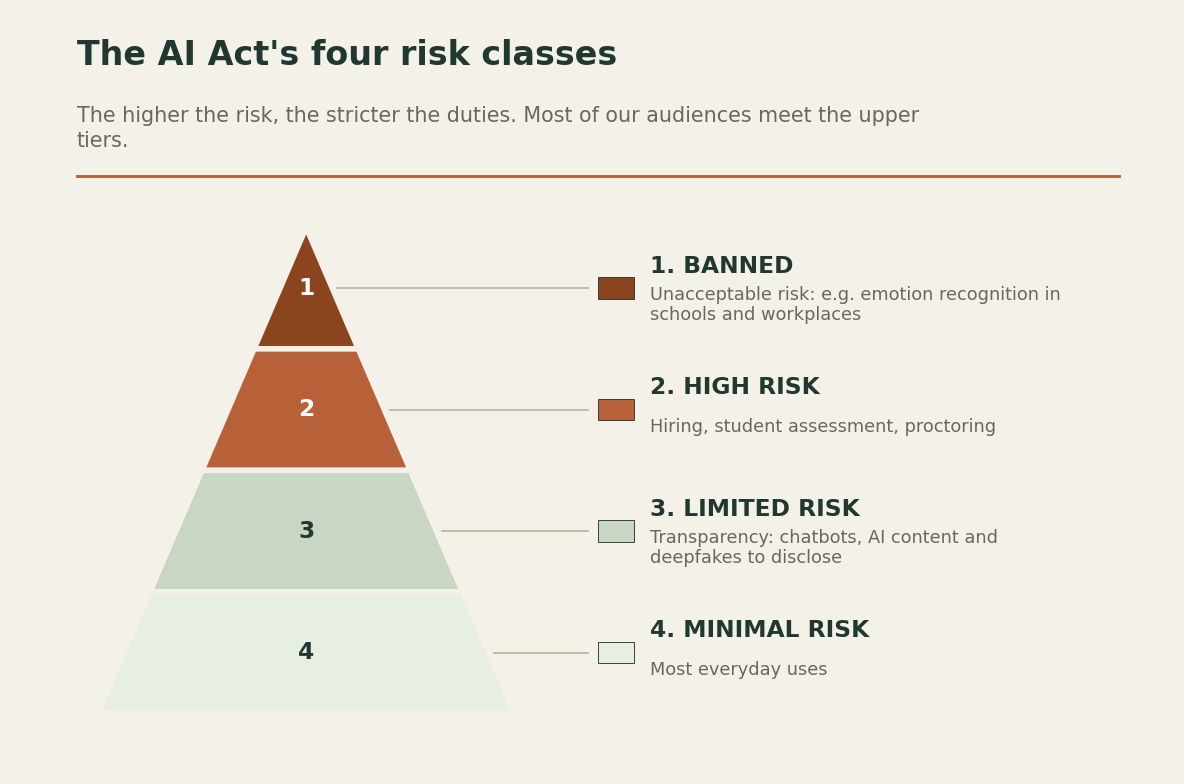
The AI Act's four risk classes. Source: Regulation (EU) 2024/1689.
Some practices are simply banned, and have been since 2 February 2025. Two of them touch our audiences directly: emotion recognition in the workplace and in educational institutions, and social scoring systems. Software that claims to measure the attention or emotional state of students or employees cannot be used in Europe today.
Above the high-risk threshold sit lawful but sensitive systems, such as those used to select staff or to assess students: lawful, but subject to strict duties. Below come limited risk, which mainly requires transparency (clearly stating when you are interacting with an AI or when content is artificially generated), and minimal risk, which covers most everyday uses.
The deadlines: why 2026 is the pivotal year
The Regulation entered into force on 1 August 2024, but its rules switch on in phases.

The AI Act timeline, with the deferral proposed by the Digital Omnibus. Source: AI Act; European Commission.
Since 2 February 2025 the bans and the AI literacy obligation (Article 4) have been in force. Since 2 August 2025 the obligations for general-purpose AI models (GPAI) and governance have applied. 2 August 2026 is the date many are watching: transparency obligations apply and supervision begins, including supervision of AI literacy.
Here honesty about the present is needed, because the picture is shifting. The heaviest obligations on high-risk systems in Annex III were expected precisely on 2 August 2026, but under the Digital Omnibus — a simplification package on which the EU institutions reached a provisional political agreement in May 2026 — they would be deferred to 2 December 2027. Note, however, that the deferral only takes effect once formally adopted and published in the Official Journal. Until that happens, the original deadlines stand. In other words: this is not the time to wait, but to prepare.
The duty that already concerns everyone: AI literacy
There is one duty that does not depend on the risk level and is already fully in force: AI literacy, Article 4. Since 2 February 2025, anyone who provides or uses AI systems must ensure a sufficient level of competence in those who use them on their behalf.
Two details make it especially relevant. The first is its breadth: it applies to every organisation, whatever the risk of the systems used, and covers not only employees but also contractors, suppliers and clients who use AI on the organisation's behalf. The second is the timing of supervision: the Commission has clarified that monitoring and enforcement of this rule start on 2 August 2026. So it is not an optional good practice: it is a legal obligation, on which the Commission has already issued an official Q&A (May 2025).
This is where compliance and Retoria's mission coincide perfectly: training people is no longer just a smart choice, it is what the law requires.
Where high-risk kicks in, for schools and companies
Annex III lists high-risk uses, and two areas concern our audiences closely.
In education: systems used to decide admissions, to assess learning outcomes, or to monitor students during exams (proctoring). A school adopting such tools is not the provider of the technology but its deployer, and still has its own obligations, including human oversight and informing the people involved.
In work: systems for staff selection, application screening, evaluation, and decisions on promotions or terminations. This is where companies and professional firms using AI-based recruiting or assessment software fall.
In these cases the obligations are concrete: ensure competent human oversight, use the systems according to the instructions, monitor how they work, and — for Annex III systems — in many cases carry out a fundamental rights impact assessment (FRIA).
The AI Act and the GDPR: two rules, one system
None of these systems lives without personal data. That is why the AI Act and the GDPR must be read together.

22 of the 25 high-risk Annex III cases also require a DPIA (GDPR).
Classifying a system as high-risk under the AI Act triggers a presumption of high risk under the GDPR too, and therefore the need for a data protection impact assessment (DPIA): according to recent analysis, 22 of the 25 high-risk Annex III cases also require a DPIA. The legislator anticipated this: deployers of high-risk systems can reuse the information provided by the producer (Article 13 of the AI Act) to build the DPIA, and the AI Act's FRIA integrates with it.
The GDPR's core principles still apply: a valid legal basis for processing data, minimisation, transparency toward data subjects and safeguards against fully automated decisions (Article 22). The EDPB has already addressed this interplay with Opinion 28/2024 on AI models and personal data, and joint EDPB–Commission guidelines on the interaction between the two laws are expected. The practical message is simple: you cannot make AI compliant while ignoring privacy, or vice versa.
The cost of non-compliance
The AI Act's fines are designed to be felt.
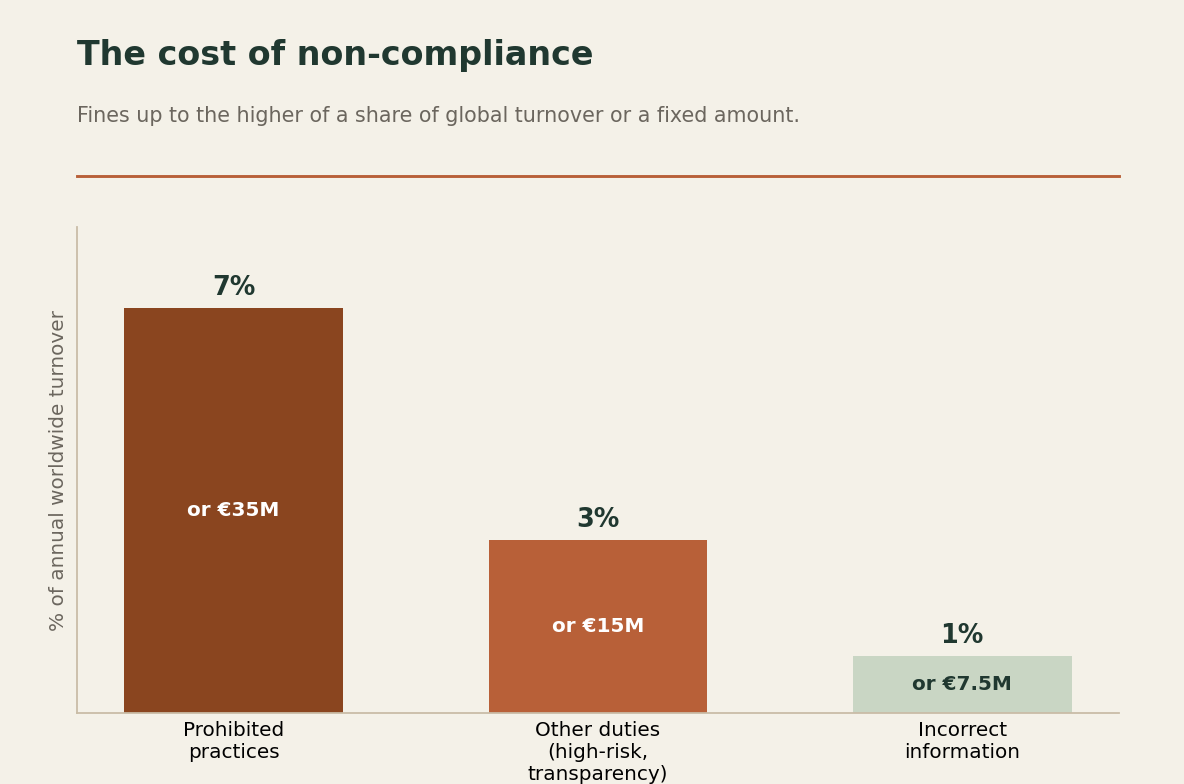
The AI Act's three tiers of fines. Source: Regulation (EU) 2024/1689.
They reach up to €35 million or 7% of annual worldwide turnover for prohibited practices, up to €15 million or 3% for breaching the other obligations (including those on high-risk and transparency), and up to €7.5 million or 1% for incorrect information given to authorities. In the most serious cases, the higher of the percentage and the fixed amount applies.
The point, though, is not fear. It is that the cost of inaction is real, while the first step to reduce it is also the quickest and cheapest: train people and put your tools in order.
How Retoria helps you navigate the rules
Retoria is not a law firm and does not replace your legal counsel or your DPO. It does something different and complementary, which is often the weak link in compliance: it brings awareness and competence into the organisation, in coordination with those who handle the legal side. Here is how, for the three audiences.
- Schools and teachers. AI literacy programmes for teachers and staff that fulfil the Article 4 obligation; a mapping of the tools already in use (registers, learning platforms, assessment or proctoring systems) to understand what is banned, what is high-risk and what is not; support in drafting a usage policy and coordinating with data protection.
- Companies and workers. Role-appropriate staff training (Article 4), an inventory of the AI systems in use, risk classification, setting up governance with effective human oversight, and preparing the ground for DPIA and FRIA, in dialogue with the DPO.
- Professional firms. Conscious use of generative AI that respects confidentiality and the GDPR on client data, transparency obligations toward third parties, and team literacy — because the most powerful safeguard remains a professional who knows what they are doing.
It all starts from the same diagnosis: our AI Readiness Report shows where you stand and where it makes sense to begin.
What to do now, in practice
A few steps, in the right order, immediately reduce exposure:
- Appoint an internal AI lead.
- Inventory the AI systems actually in use.
- Classify their risk (banned, high, limited, minimal).
- Start staff training: it is already an obligation, not a deferrable investment.
- Coordinate the AI Act and the GDPR, with a DPIA where needed and updated privacy notices.
- Document your choices and keep an eye on the evolving rules (starting with the Digital Omnibus).
AI Act compliance is not a cost to endure but a way to use AI seriously and reliably. And the first defence against fines is not software: it is aware people. That is exactly what we do. To go deeper, read our manifesto, our article on AI and the brain, or write to us.
Note
This article is informational and explanatory and does not constitute legal advice. The AI Act's regulatory framework is evolving: some deadlines, particularly those on high-risk systems, depend on the formal adoption of the Digital Omnibus. For specific decisions, consult your legal advisors and your DPO.
Sources
- Regulation (EU) 2024/1689 (AI Act) — text and Article 4 (AI literacy).
- European Commission — AI Literacy, Questions & Answers (May 2025).
- European Commission — Digital Omnibus on AI (19 November 2025) and provisional political agreement (May 2026) on deferring high-risk obligations.
- EDPB — Opinion 28/2024 on AI models and personal data; EDPB–EDPS, Joint Opinion on the Digital Omnibus (January 2026).
- AI Act Annex III — high-risk uses in education and employment.
- Analysis of the GDPR–AI Act interplay and DPIA/FRIA requirements (legal literature and law-firm guidance, 2025–2026).
Download the Free AI Act Guide for Organizations
A practical guide to quickly grasp legal obligations, avoid penalties, and prepare educators, employees, and professionals ethically and safely.
What you will find inside:
- Three-step checklist to instantly comply with active prohibitions.
- Training and AI Literacy obligations of Article 4 (already active).
- How to align AI Act compliance with GDPR's DPIA requirements.
- Clear instructions for schools and businesses on high-risk systems.
Guide on its way!
Thank you for your interest. We've sent the AI Act Guide to the email provided. Please check your inbox (and spam folder). You can also download it directly below:
An error occurred. Please try again or contact us directly at [email protected].