Homework 30% faster and exam scores down 20%, the AI paradox in a study of 26,000 students
In education completing an assignment is never the end goal. It is the tool through which a mind learns to think. When a knowledge worker uses generative artificial intelligence to finish a task in half the time, that gain in efficiency produces real economic value. When a teenager does the same with school homework, that efficiency risks becoming a cognitive trap, because it bypasses the intellectual effort that builds lasting understanding.
Until recently public discussion on classroom AI swung between uncritical tech optimism and short lab experiments lasting only a few hours. In June 2026 a team of economists from Stockholm University and the University of Hong Kong (David Strömberg, Victor Lei and Yanhui Wu) published the first large-scale longitudinal study on the topic, tracking 26,811 secondary school students aged 12 to 18 (grades 7 to 12 across middle and high schools) over thirty consecutive months. Their findings show with mathematical precision what happens when teenagers adopt generative AI in everyday school life.
The educational productivity paradox
The researchers tracked nine academic subjects, matching homework completion times and scores with monthly closed-book exam grades and high-stakes entrance exams. Because individual students started using generative AI at different points in time over the thirty-month window, the authors could rigorously compare each student's trajectory before and after adoption against peers who had not yet adopted or never adopted the tool.
The empirical data reveal an immediate and striking divergence between task productivity on homework and genuine skill acquisition.
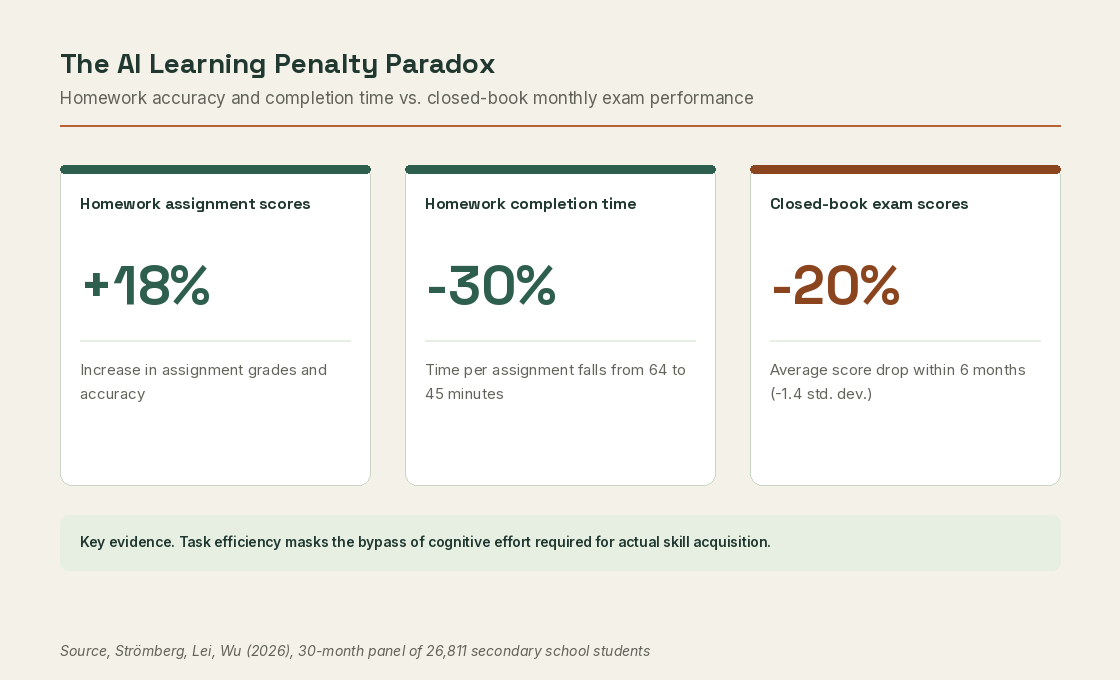
The AI learning penalty paradox. Homework performance vs. closed-book exam results. Source, Strömberg, Lei, Wu (2026).
On homework assignments generative AI delivers an immediate productivity leap. After five months of adoption the average time needed to finish an assignment falls from 64 to 45 minutes (a 30% drop) while homework grades rise by 18%.
In the classroom the exact opposite happens. On monthly closed-book exams, where digital tools are absent, the test scores of AI users drop by 20% of the baseline mean, an effect size of 1.4 standard deviations.
This divergence breaks an established rule of schooling. In traditional education homework scores reliably predict exam success, because effort at home reinforces mastery. With generative AI that link turns upside down. Among students who use AI, those with the highest homework scores receive the lowest exam grades. High homework grades no longer signal subject mastery, but rather the depth of technological delegation.
Penalties accumulate over time
One of the study's central discoveries concerns time dynamics. While the drop in monthly tests surfaces within six months, the penalty on fundamental human capital takes much longer to reveal its full severity.
The authors analyzed high-stakes entrance exams, namely the Zhongkao (the standardized exam determining admission to academic high schools) and the Gaokao (the national college entrance examination).

Learning penalty progression from initial adoption to high-stakes entrance exams at 24 months. Source, Strömberg, Lei, Wu (2026).
Two years after AI adoption, exam scores decline by 24% on the Zhongkao (1.5 standard deviations) and by 18% on the Gaokao (1.3 standard deviations).
This pattern explains why short-term studies run over a single class or a few weeks can mislead educators and policymakers. In the short run AI provides quick answers and creates an illusion of competence. In the long run skipped practice atrophies fundamental conceptual structures, leaving students unprepared when facing complex problems on their own.
As we documented in our investigation on cognitive debt and brain connectivity, intellectual effort deferred today becomes an accumulated deficit tomorrow.
Outsourcing vs. tutoring, the choice of 81%
The authors emphasize that generative AI does not harm learning through some inevitable property of the technology, but through how teenagers naturally deploy it.
Looking at the distribution of study time, two distinct groups emerge.
Roughly 81% of AI users engage in homework outsourcing. These students finish assignments in under fifty minutes (faster than the fastest non-AI student), receive stellar grades at home, and consistently underperform on closed-book tests. They use the tool to clear their workload quickly, bypassing the friction of learning.
The remaining 19% of AI users maintain study times above 65 minutes per assignment, matching traditional peers. This minority uses AI to explore alternative explanations, test difficult arguments, and quiz themselves. For this group the learning penalty is near zero.
The structural problem is clear. When given unrestricted access to free general-purpose chatbots that deliver immediate answers, four out of five teenagers choose the path of least resistance.
From social sciences to STEM, which subjects suffer most
The study provides the first comprehensive measurement of AI learning effects across all major secondary school disciplines.

Learning loss by academic discipline on school exams. Source, Strömberg, Lei, Wu (2026).
The sharpest decline occurs in the social sciences (history, civics, geography), with an average score drop of 27%. In these subjects the temptation to outsource essay drafting and summary writing is overwhelming. When students skip primary text analysis and avoid synthesizing arguments in their own words, historical and conceptual reasoning quickly fades.
Next come STEM subjects (mathematics, physics, chemistry, biology), with an average decline of 22%. In mathematics the drop equals 0.84 within-subject standard deviations. Outsourcing step-by-step calculations robs students of the procedural practice needed to tackle novel problems during in-class exams.
Language disciplines show an apparently smaller decline, with English falling by 17% and native language study by 9%. This should not offer comfort. While in STEM disciplines the loss of calculation skills shows up immediately on classroom quizzes, true logico-linguistic decay operates at a much deeper and quieter level. The narrowing of vocabulary, syntactic simplification, and the loss of capacity for nuanced argumentation do not instantly register on multiple-choice tests, but compound over years. Tracking the genuine erosion of language mastery and critical thought will likely require studies across even longer horizons. A drop near ten to twenty percent within just two years is an urgent warning sign, not a reason for relief.
Age, dose response and prior academic achievement
The research identifies three additional risk factors for schools and parents.
- Student age. Lower secondary students (middle school, ages 12 to 15) suffer a 24% drop, compared with 17% among upper secondary students. Younger teenagers possess less metacognitive self-regulation and face less structured supervision at home.
- Dose response. The penalty grows strictly with usage time. Students reporting under one hour of weekly AI use see a modest 5% drop, whereas those exceeding five hours per week experience a 30% drop.
- Prior achievement. Counterintuitively, previously top-performing students experience the largest absolute losses. Before AI arrived, high achievers succeeded because they invested deep focus into problem solving. When they outsource that effort to an algorithm, they turn off the very study habits that generated their academic edge.
The Retoria approach, changing student posture without banning tools
The evidence confirms the founding principles of Retoria. Banning generative AI or pretending teenagers will not use it outside school is ineffective. Students will continue accessing models on their phones at home.
The real educational challenge is cultivating an active posture, turning AI into a cognitive gym rather than a provider of convenient ready-made answers.
In our training programs for schools, principals, and educators we implement four core principles.
- Formulate with your own mind before prompting the model. No student queries AI without first writing an initial draft or outlining a solution on paper.
- Use AI as a sparring partner, never as a ghostwriter. The tool is used to challenge hypotheses, identify logical flaws, and simulate dialectical debates, never to generate finished work.
- Closed-book in-person assessments remain essential. Schools must preserve handwritten, unassisted evaluation, helping students recognize that intellectual effort is the biological mechanism through which durable skills are built.
- Language and critical judgment stay at the center. Directing AI requires superior linguistic precision, not less. A person who cannot formulate clear conceptual distinctions cannot critically evaluate an algorithm's output.
Generative artificial intelligence can become a powerful intellectual amplifier, but only when paired with a human mind already trained to think.
Looking to assess your school's AI readiness and build human-centric training programs for teachers and students? Contact us for an institutional evaluation or discover our educational mission.
Methodological note
The research by David Strömberg, Victor Lei and Yanhui Wu tracks a panel of 26,811 secondary school students (grades 7 to 12, ages 12 to 18) across five junior high and four senior high schools in central China (county population over 1 million, GDP per capita around 6,000 US dollars). The dataset covers thirty consecutive months from September 2022 to June 2025, recording homework times, assignment accuracy, monthly closed-book exams, and high-stakes standardized entrance exams (Zhongkao and Gaokao).
Econometric identification relies on staggered AI tool adoption within a difference-in-differences framework using the Callaway and Sant'Anna (2021) regression adjustment estimator, cross-validated with Sun and Abraham estimators and pre-adoption parallel trend tests.
Sources
- David Strömberg, Victor Lei, Yanhui Wu, The Generative AI Learning Penalty: Evidence from Chinese Secondary Education (Working Paper, University of Hong Kong & Stockholm University, 2026).
- Hamsa Bastani, Osbert Bastani, Haosen Sung, Haoyu Ge, Peter Kabakçı, Rei Mariman, Generative AI Can Harm Learning, SSRN Electronic Journal (2025).
- Greg Kestin, Kelly Miller, Logan S. McCarty, AI tutoring outperforms active learning in physics, Harvard University & Physics Education Research (2025).
- Nataliya Kosmyna et al., Your Brain on ChatGPT: Accumulation of Cognitive Debt when Using an AI Assistant for Essay Writing, MIT Media Lab (2025).
- Daron Acemoglu, David Autor, Simon Johnson, The Macroeconomics of Artificial Intelligence, NBER Working Paper (2026).