Technology cannot become the measure of what is human. Now the law says so too
On 10 June 2026, the Italian Council of Ministers gave preliminary approval to the two implementing decrees of Italy's artificial intelligence law. Within the thirty pages of the official statement there is one sentence worth more than a hundred conferences. Training is "the enabling condition of the national AI strategy". Not technical drill, the text specifies, but "critical literacy, awareness of risks, the ability to interpret outputs, responsibility in the use of these tools".
Those who work in education have been arguing this for years, often preaching in a desert crowded with tutorials. Now the Italian State has written it down as the foundation of the first comprehensive national regulatory framework on artificial intelligence in Europe.
The chain that leads here
This choice does not come out of nowhere, it is the latest link in a precise regulatory chain. The first link is European, namely Article 4 of the AI Act (EU Regulation 2024/1689), which makes AI literacy a legal duty for those who develop and those who deploy these systems, we covered it in detail here. Not an invitation, an obligation.
The second link is Italian Law 132 of 2025, which translated that principle into a mandate for the Government. The third is the decrees of 10 June, which turn the mandate into concrete rules for schools, universities, public administration, healthcare, the professions, the workplace and the judiciary.
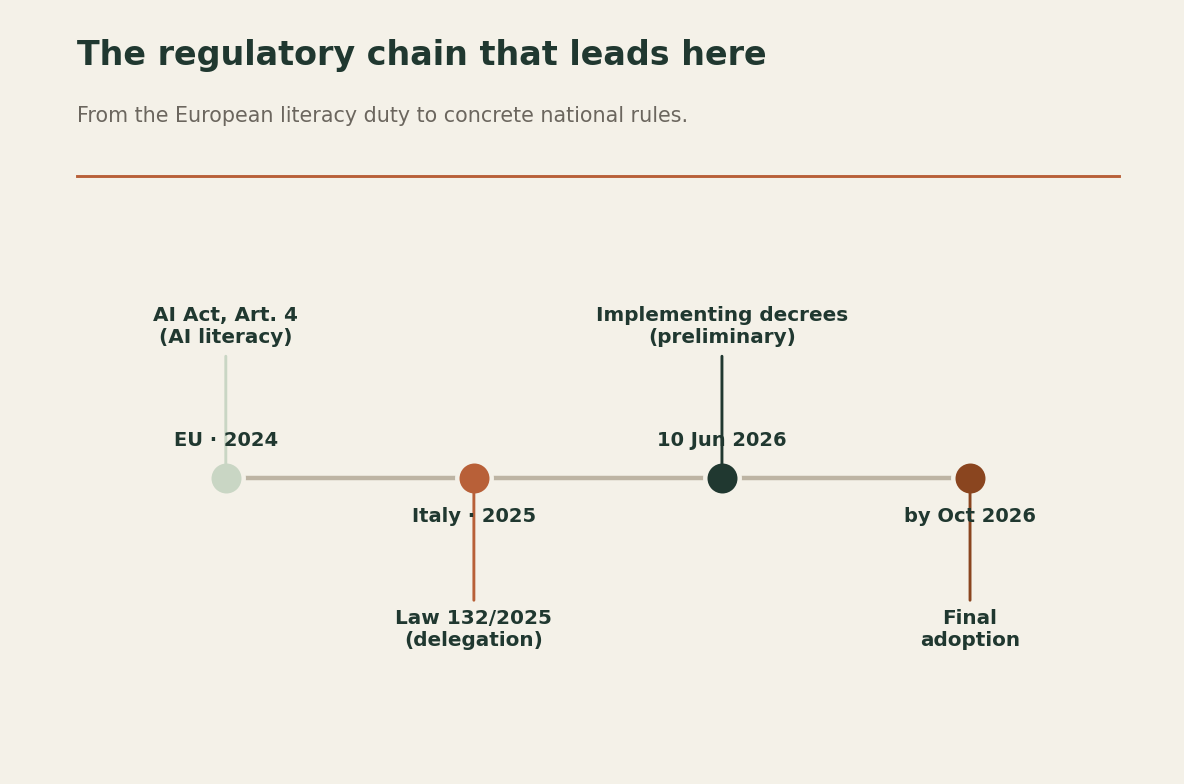
The regulatory chain, from the AI Act to the Italian decrees. Source AI Act, Law 132/2025 and Council of Ministers (10 June 2026).
One honest caveat before going further. The decrees are at the preliminary stage, meaning they still need to pass through parliamentary committees, the Regions and the competent authorities, with final approval expected by October. Details may change, the architecture hardly will.
Human-centric is not a slogan
The word running through the entire package is "human-centric". It is a term that risks wearing out in press releases, yet in the decrees it has a precise operational meaning, namely that responsibility is never delegated to the machine.
Three examples make the point. A dismissal decided solely by an algorithm is null and void, because decisions affecting a person's working life must remain attributable to a human being with real powers. A judge may use AI to organise and search, but judging remains theirs. A professional who uses AI systems answers for them personally, and responsibility does not transfer to the tool.
One thread connects these three cases. AI may support human judgement, not replace it. And a principle like this works on one condition only, namely that people genuinely know how these systems work, where they fail, how their outputs should be read. This is why training is not one chapter of the package. It is the pillar holding up all the others.
What it provides, concretely
In schools, AI enters the curriculum permanently, namely in the national guidelines for upper secondary education, in civic education, in STEAM skills and in guidance. Stable teacher training is planned, covering how the systems work, error and bias risks, and data protection. A 100 million euro plan addresses the educational emergency linked to the misuse of social media, platforms and AI, involving families as well. Territorial technical-ethical committees will support schools.
For adults, structured literacy pathways arrive, with recognition of prior skills and support for professional retraining. For public administration, basic literacy for all employees and advanced training for managers. For the professions, the orders will have six months to embed AI literacy into mandatory training, on three levels, namely technical, legal and ethical. For healthcare, a dedicated quota within continuing medical education.

AI training reaches every professional field, source implementing decrees of 10 June 2026.
Read as a whole, the message is single, namely that no sector of Italian professional life will be exempt from the obligation to understand artificial intelligence. Not to use it, to understand it.
Where we stand
Retoria was founded on exactly this thesis, before it became law. We do not teach the latest tool, which will be obsolete in six months. We work on critical literacy, namely understanding how these systems reason, where they fail, what remains irreplaceably human, and how to build a collaboration between person and machine in which the person orchestrates and the machine executes.
It is also how we ourselves work. Inside Retoria, AI drafts, analyses and automates, while every decision that matters remains human, tracked and signed. For us, human-centricity is not a conference word, it is our daily working method, from the school classroom to the internal workflow that produced this very article.
In the coming months the decrees will become final and the obligations will become deadlines, for schools, for professional orders, for companies. On this Observatory we will follow them step by step, in plain language, separating what is already operational from what is still under discussion.
The question we leave to the reader is the same one the legislator has implicitly asked the whole country. Not whether to use artificial intelligence, but with how much awareness. The difference between the two is called training, and now the law says so too.
To prepare your organization for the obligations ahead, you can get in touch here, discover the Retoria method, or read what the AI Act means for schools, companies and firms.
Sources
- Regulation (EU) 2024/1689 (AI Act) — Article 4 (AI literacy).
- Italian Law 132/2025 on artificial intelligence.
- Council of Ministers statement of 10 June 2026 (implementing decrees, preliminary stage).
- Ministerial Decree 219/2025.