
The productivity paradox, buying AI is not enough
Over the past two years companies have bought artificial intelligence like never before. Then the bill arrives. According to the MIT report The GenAI Divide: State of AI in Business 2025, 95% of enterprise generative-AI projects produced no measurable impact on the bottom line. Only 5% create real value. And not because of the technology.
The paradox is simple, namely buying the tool is easy and fast, while transforming thanks to that tool is another matter entirely. It is what economists have for decades called the "productivity paradox".
Huge investment, rare return
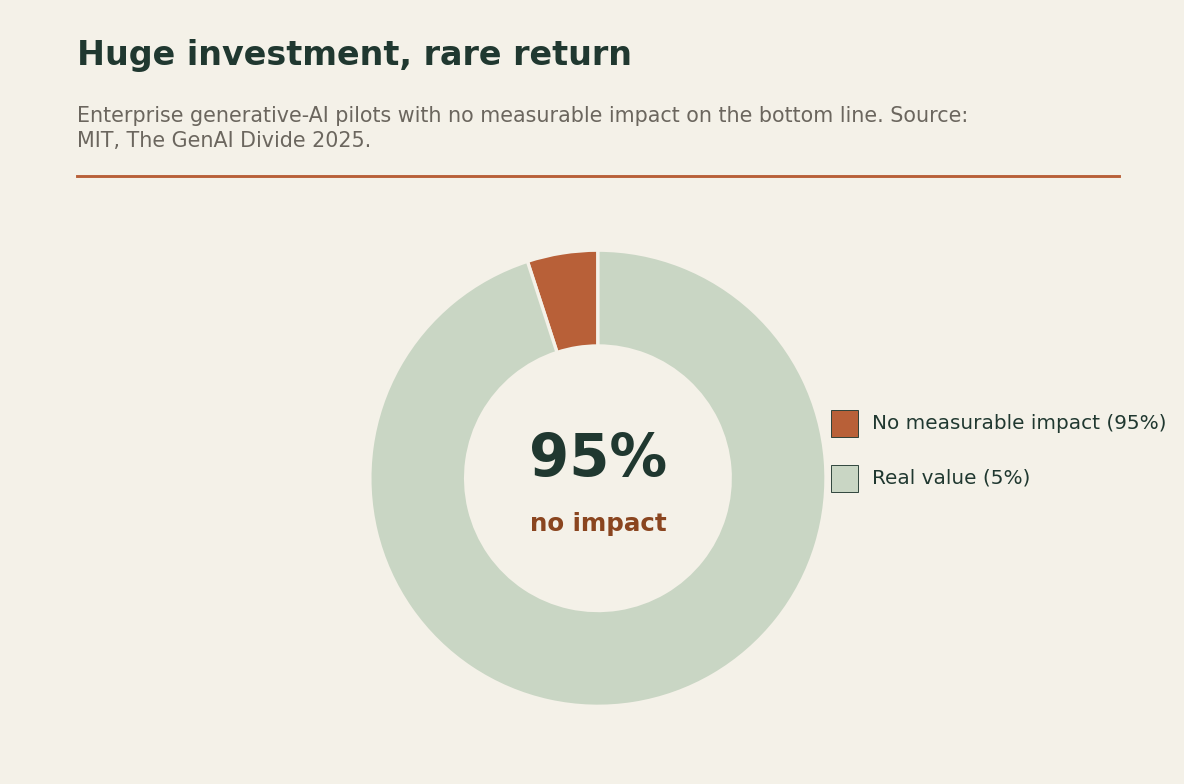
Enterprise generative-AI pilots with no measurable impact. Source MIT, The GenAI Divide 2025.
MIT analysed around 300 deployments, 153 executives and dozens of interviews. The result, against 30 to 40 billion dollars invested, is that 95% of projects show no return. The cause, the researchers say, is not model quality but the "learning gap", namely the difficulty organisations and people have in genuinely embedding AI into how work gets done.
Freed-up time to do what
There is a line, gathered from interviews with top management in the EduNext 2026 report, that captures the problem, namely "we free people from certain tasks, fine, but what do we have them do with the time gained?". Without an answer, automation produces individual productivity, not organisational transformation. AI saves each person a few minutes, but if roles, processes and skills stay the same, those minutes scatter without becoming value.
Three wrong ways to operate with AI
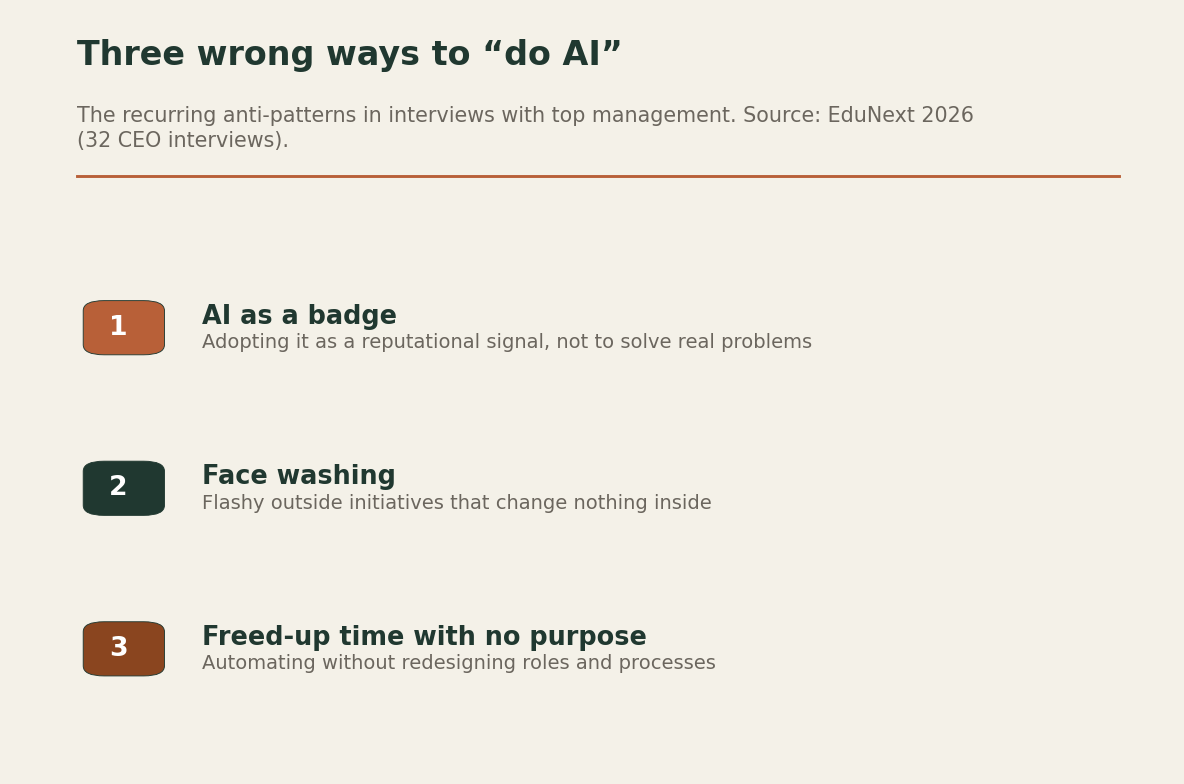
The recurring anti-patterns in CEO interviews. Source EduNext 2026.
The same interviews reveal three recurring mistakes. The first is AI as a badge, namely adopting it as an image signal, to say "we use it too", rather than to solve a real problem. The second is face washing, namely flashy outward initiatives that change nothing in internal processes. The third is freed-up time with no purpose, namely automating without redesigning roles and ways of working. In all three the tool is there, but the transformation is not.
Where the return actually is
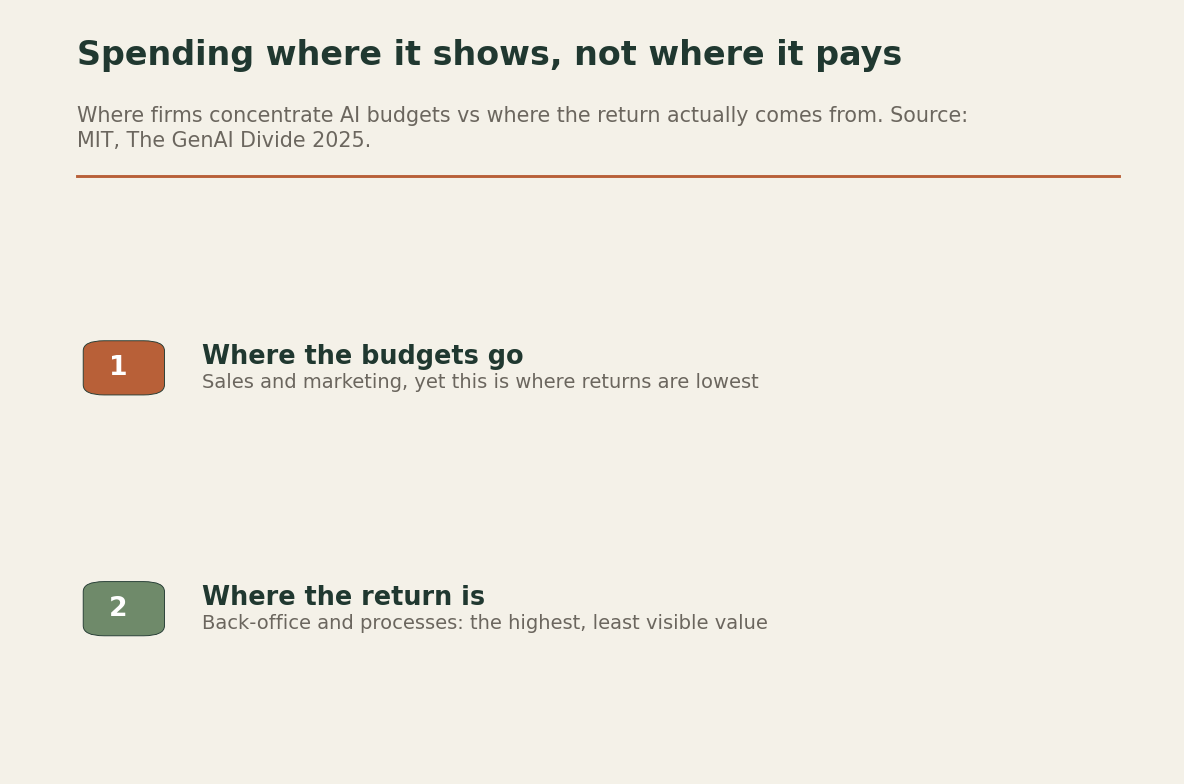
Where firms concentrate budgets versus where the return comes from. Source MIT, The GenAI Divide 2025.
There is also a misallocation. Budgets concentrate on sales and marketing, where returns are lowest. The highest value, MIT notes, comes from the back-office and processes, namely less visible, but more profitable. Firms spend where it shows, not where it pays.
A paradox that goes back a long way
This is not new. In a landmark 2017 study, economists Brynjolfsson, Rock and Syverson described the "modern productivity paradox", namely that general-purpose technologies, such as AI, deliver benefits only when paired with co-investment in skills and reorganisation. The impact is asymmetric, given that few organisations capture it and many fall behind. The technology is the same for everyone, since the difference is what you build around it.
What makes the difference, namely the after
The lesson is consistent across the studies. Technology alone does not transform. The difference is made by three things that come after the purchase, namely redesigning roles and processes around AI, training people to use it with judgement, and giving a purpose to the time it frees. This is exactly what Retoria does with organisations, namely not selling tools, but building the conditions for those tools to create value, namely skills, method and human oversight.
To assess the real return on AI and evaluate your organization's AI readiness, you can get in touch here, discover the Retoria method, or read why Italy is second-to-last in Europe for AI use.
Methodological note
Data on the lack of return from enterprise AI projects come from the MIT report The GenAI Divide: State of AI in Business 2025 (analysis of around 300 deployments, 153 executives, over 50 interviews). Quotes from top management and the anti-patterns are drawn from the EduNext 2026 report (Luiss and Intesa Sanpaolo, CC BY 4.0). The theoretical frame of the "productivity paradox" refers to the economic literature on general-purpose technologies.
Sources
- MIT — The GenAI Divide: State of AI in Business 2025 (summary).
- Brynjolfsson, Rock & Syverson — Artificial Intelligence and the Modern Productivity Paradox (NBER, 2017).
- Look4ward Observatory, Luiss & Intesa Sanpaolo — EDUNext 2026 (CC BY 4.0).