Homework up 18% and exams down 20%, the error is in the rubric
A habitus is the set of deep habits with which a person approaches problems, the ones they no longer choose each time because they have already internalised them. Pierre Bourdieu described it as a system of durable, transposable dispositions, that is, structures built by an environment which then, in turn, structure behaviour in new environments. Translated into a school, it means something very concrete. The mental habits a student picks up at sixteen travel with them into the workplace at twenty-six.
The EduNext report, published in 2026 by the Luiss Look4ward Observatory together with the Intesa Sanpaolo Research Department, identifies secondary school as the structurally weakest link in the whole education ecosystem, and the reason it gives is exactly this. That is where the fundamental cognitive habitus is formed, and that is where the system has stayed essentially still. The question this article tries to sharpen is narrower, namely what actually builds that habitus. The answer emerging from the research of the past two years is uncomfortable for anyone who teaches and useful for anyone who wants to change something, because it is not the lesson, it is not the ban and it is not the tool. It is assessment.
What you assess is what people learn to do
Education research has a technical name for this mechanism, the backwash effect of assessment. Students do not organise their work around the goals stated in the syllabus, they organise it around whatever will be measured. John Biggs built the principle of constructive alignment on top of it, arguing that objectives, activities and tasks must all point the same way, otherwise the task always wins. David Boud put it more bluntly, reminding us that students can escape from bad teaching but they cannot escape from bad assessment.
This was true long before AI. If the test rewards recall, the student develops the habit of recalling. If it rewards procedure, they develop the habit of executing. What is new is that a tool now exists that can produce the finished output without the process happening at all, and most rubrics only look at the finished output. That is why the rubric is not a piece of paperwork. It is the machine that manufactures the habitus.
The homework improves, the learning gets worse
The strongest evidence comes from a study by David Strömberg, Victor Lei and Yanhui Wu (2026) covering 26,811 Chinese students from grade 7 to grade 12, followed for thirty months with real administrative data, namely homework, monthly closed-book tests and entrance exams across nine subjects. Staggered AI adoption across schools allowed the effect to be estimated with a difference-in-differences design, which is about as close to an experiment as you can get in a real school.
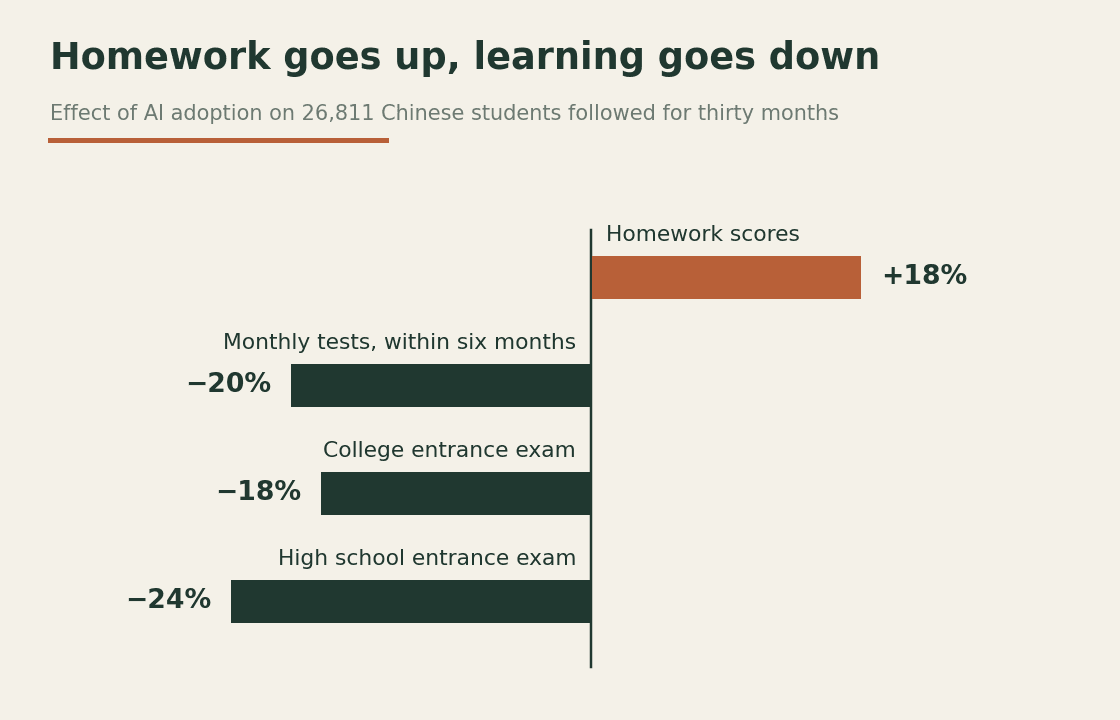
What you see straight away and what is left afterwards, in the study of 26,811 students. Source. Strömberg, Lei and Wu (2026).
Homework scores rise by 18 per cent and the time spent on homework falls by 30 per cent. Within six months, monthly test scores drop by 20 per cent. On the entrance exams, the ones that really count, the loss reaches 18 per cent on the university entrance exam and 24 per cent on the high school entrance exam, and the full damage only shows up after roughly two years. The decisive detail is elsewhere. The losses are concentrated in around 80 per cent of AI users whose behaviour matches homework outsourcing, recognisable from extremely short completion times paired with high homework marks. Those who keep spending the same time as before suffer minimal losses.
The same tool, in the same classrooms, produces two opposite outcomes depending on the habit it is used with. And the piece of work handed in, on its own, does not tell the two groups apart.
Same model, two different habits
That the habit can be designed is shown by a randomised experiment run by Hamsa Bastani, Osbert Bastani, Alp Sungu and colleagues, published in 2025 in the Proceedings of the National Academy of Sciences, on almost a thousand students at a large Turkish high school, from grade 9 to grade 11. Two groups were given the same GPT-4 model behind two different interfaces. The first was a generic assistant. The second had been built by the teachers so that it would never give the solution, only hints, common mistakes and follow-up questions.
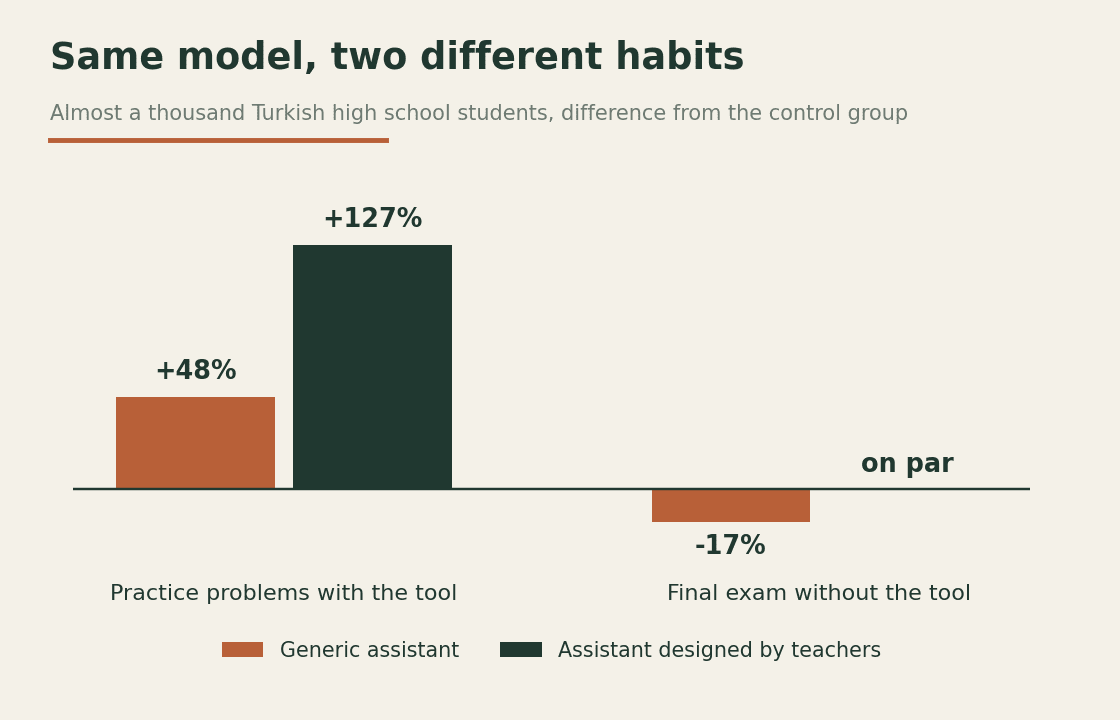
The visible gain on practice problems and the result on the exam without tools. Source. Bastani and colleagues (2025).
On practice problems done with the tool available, results rise in both cases, by 48 per cent with the generic assistant and by 127 per cent with the one the teachers designed. Then the tool is taken away and the closed-book exam arrives. The generic assistant group performs 17 per cent worse than the control group. The designed assistant group is essentially level with the control group.
This is the point worth holding on to. It is not AI that determines the outcome, it is the kind of interaction you ask of it. And if you only measure the practice work, both groups look brilliant to you, in fact the group learning less looks like it improved less.
«Rushing AI adoption is not an ally. It is the fastest route to wasting resources and creating resistance that then costs twice as much.»
Why the output improves while the process shuts down
The internal mechanism has been observed directly. In a study published in the British Journal of Educational Technology, Yizhou Fan and colleagues (2025) assigned 117 university students to four conditions, that is, no support, ChatGPT, a human expert and a checklist-based writing analytics tool. The ChatGPT group produced the best-scoring essays, yet showed no significant difference in knowledge gain or in the ability to transfer that knowledge to a new task.
The trace data explain why. Students working with ChatGPT spent far less time on orientation and on evaluating their own work, cycling between asking and revising without pausing to judge. The authors call this behaviour metacognitive laziness. The output improves precisely because the process that builds learning gets skipped.
In Italy the habitus is already formed
Meanwhile the habit has settled in. The national survey Io e l'Intelligenza Artificiale, run by INDIRE with the Festival dell'Innovazione Scolastica between March and June 2026 on 5,342 lower and upper secondary students, shows a clear picture.
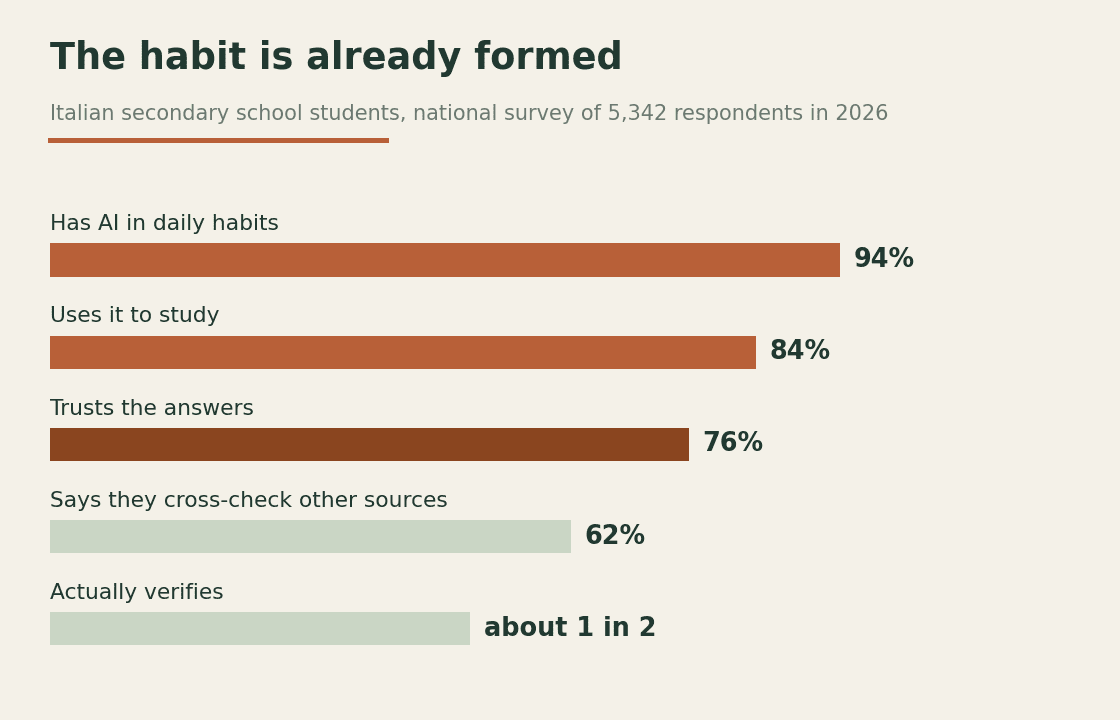
How far AI has entered the study habits of Italian students. Source. INDIRE and Festival dell'Innovazione Scolastica (2026).
Ninety-four per cent of students now have AI inside their daily habits and more than 84 per cent use it to study. Seventy-six per cent trust the answers, 62 per cent say they cross-check them against other sources, and in practice only about one in two actually verifies. So this is not an access problem, and there is no point arguing about it as though it were. It is a problem of quality of use, which is another way of saying habitus.
On this point the EduNext report adds a passage worth reading twice. School bans do not remove the use, they produce the habit of hiding it, and that habit transfers intact into workplaces as shadow AI, a widespread but submerged practice that nobody can govern or turn to account. Whoever learned to conceal at school conceals at work. A ban builds no critical skill at all. It builds a practice of concealment, and practices of concealment are habitus in the fullest sense.
What builds a different habitus
The direction the research converges on is neither banning nor deregulating. It is moving the object of assessment from the answer to the process that produced it. The paper Assessment reform for the age of artificial intelligence, written by Jason Lodge, Sarah Howard, Margaret Bearman and Phillip Dawson for the Australian regulator TEQSA in 2023, lists the process of learning among its five propositions, alongside security concentrated at a few meaningful points of a programme rather than everywhere.
From there comes the two-lane approach adopted by the University of Sydney and since picked up by many institutions. The first lane holds a small number of supervised, in-person tasks where competence is actually certified, and the oral exam is the instrument of choice. The second lane holds everything else, where AI is used openly and students learn to use it well, because the job of those tasks is not to certify, it is to teach.
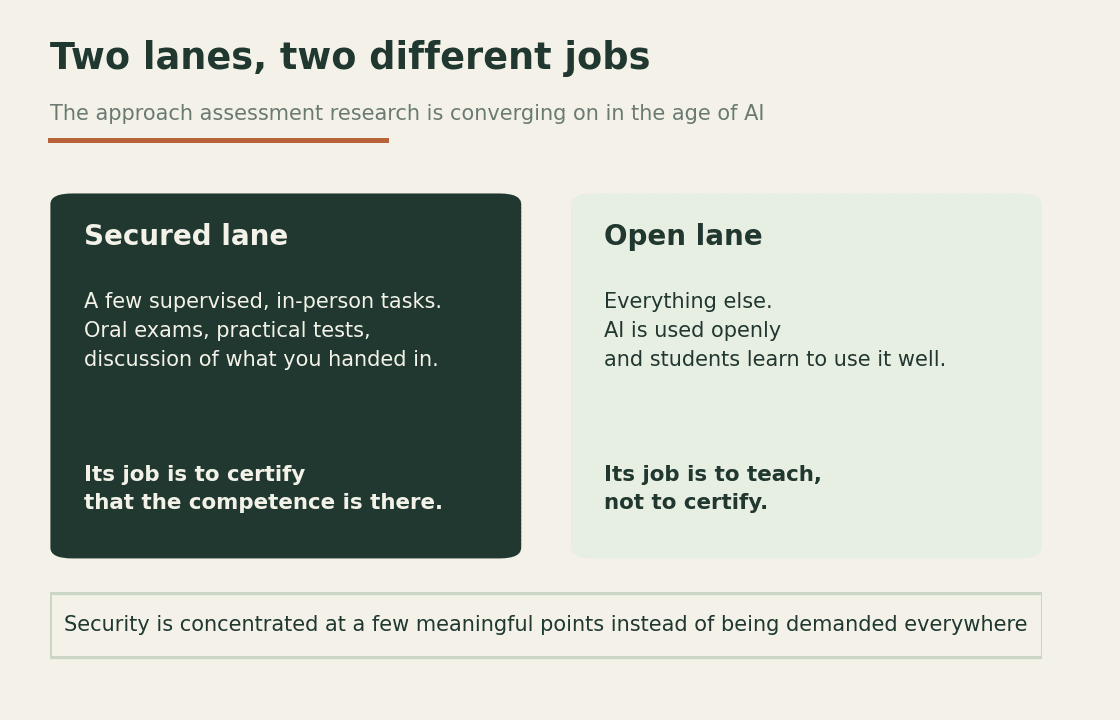
The two lanes of assessment and the different job each one does. Source. Retoria elaboration on TEQSA (2023) and the University of Sydney.
In Italy part of this movement is already law. The reform of the upper secondary school leaving exam, introduced by decree law 127 of 9 September 2025 and converted by law 164 of 2025, restores the name esame di maturità and rebuilds the oral around four subjects, with a national rubric awarding up to twenty points for command of content, the ability to connect knowledge through critical reasoning, and personal maturity. From the 2026/27 school year the exam only counts as validly taken if the candidate has sat every part of it, the oral included. The weight is shifting towards speech, the one format in which judgement can be seen while it is being formed.
Four moves you can take into class on Monday
None of these needs software, budget or permission.
- Ask for the process alongside the output. With the submission the student attaches the first version written without tools, the conversation with the AI if there was one, and three lines on what they changed and why. That gets assessed too, with a weight stated in the rubric.
- Put five minutes of oral on top of what was handed in. Three questions about the text they signed are enough to tell the student who thought it through from the student who collected it, and they cost far less than any detection software.
- Declare the lane on every task. One line saying whether AI can be used and what for. This is the move that dismantles the habit of hiding, because there is nothing to hide once the rule is written down.
- Give marks for finding the error. Hand out a machine-written text and ask students to take it apart. Reward the error they identify and argue. It is the fastest way to turn verification into a reflex rather than one more chore.
One thing matters above all of them. A habitus forms through repetition, not through announcements. A circular changes nothing, five minutes of oral repeated every week for a year change everything.
Measure it before you redesign it
If you are thinking about rewriting the assessment tasks in your school, the useful starting point is not the rubric, it is a picture of where you are now, namely how much and how students and teachers already use these tools. Get in touch for an AI readiness assessment of your school, or look at how we work before you decide. If you want the wider frame this article sits in, we have written about the shift from memory to judgement and about the learning penalty measured in secondary education.
Methodological note
The Strömberg, Lei and Wu study is observational with a difference-in-differences design, so the estimate is causal under the assumption that adoption timing is not tied to other simultaneous changes, and it covers a Chinese school setting with extremely high-stakes entrance exams. The authors themselves flag that identification is weaker precisely on the entrance exams, observed only once or twice. The Bastani study is randomised, pre-registered and peer-reviewed, but it covers a single Turkish school and mathematics alone. The Fan study has a small sample of 117 university students on a single writing task. The INDIRE survey is self-reported and voluntary, so the figures on trust and verification should be read as declared attitudes rather than observed behaviour. The EduNext report is a qualitative study based on in-depth interviews with senior figures, valuable for hypotheses and not generalisable as a statistic. Its quantitative material on the Italian context draws on Istat and Eurostat data. This article is not legal advice and does not replace reading the legislation it cites.
Sources
- Look4ward Observatory, Luiss Research Center for Strategic Change "Franco Fontana" and Intesa Sanpaolo (2026). EDUNext. Nuovi scenari per l'Education e le competenze nell'era dell'IA. Licensed CC BY 4.0.
- Bourdieu, P. (1990). The Logic of Practice. Stanford University Press.
- Strömberg, D., Lei, V. and Wu, Y. (2026). The Generative AI Learning Penalty: Evidence from Chinese Secondary Education.
- Bastani, H., Bastani, O., Sungu, A., Ge, H., Kabakcı, Ö. and Mariman, R. (2025). Generative AI without guardrails can harm learning. Evidence from high school mathematics. Proceedings of the National Academy of Sciences, 122(26).
- Fan, Y. et al. (2025). Beware of metacognitive laziness. Effects of generative artificial intelligence on learning motivation, processes, and performance. British Journal of Educational Technology.
- INDIRE and Festival dell'Innovazione Scolastica (2026). Io e l'Intelligenza Artificiale. National survey of 5,342 students.
- Lodge, J. M., Howard, S., Bearman, M. and Dawson, P. (2023). Assessment reform for the age of artificial intelligence. TEQSA.
- University of Sydney (2025). Frequently asked questions about the two-lane approach to assessment in the age of AI.
- Biggs, J. (1996). Enhancing teaching through constructive alignment. Higher Education, 32(3), 347-364.
- Decree law 127 of 9 September 2025, converted with amendments by law 164 of 2025.