
Europe cannot afford to miss the second digital revolution
285.9 billion dollars against 20.9. That is the distance between the private capital that went into artificial intelligence in the United States during 2025 and the amount that reached the whole of Europe, according to Stanford's AI Index 2026. China, in the same accounting, stops at 12.4 billion, a figure that tells only half the story, given that it leaves out most of Beijing's public push.
On 19 August 2026, speaking to the International Business Council of the World Economic Forum in Geneva, European Central Bank President Christine Lagarde placed that gap inside a wider frame. The growth model Europe has lived on for seventy years is wearing out, and artificial intelligence is where the continent decides whether it stays a market or becomes a producer again. In this Osservatorio piece we put her words next to the numbers, to see where the European lag is structural, where it is told worse than it actually is, and what an organisation can start doing today instead of waiting for Brussels.
What Lagarde actually said
The speech barely mentions algorithms. It is about three pillars weakening at the same time.
The first is trade. Expanding trade can no longer be taken for granted, and in the last year alone more than 2,500 trade restrictions were introduced worldwide. The second is mid-tech manufacturing, the European engine for decades. China now competes directly with the euro area in close to 40% of the sectors where Europe held a comparative advantage, against around 25% in the early 2000s. The third is energy, where EU electricity prices for energy-intensive industry were on average more than twice US levels and around 50% above those in China.
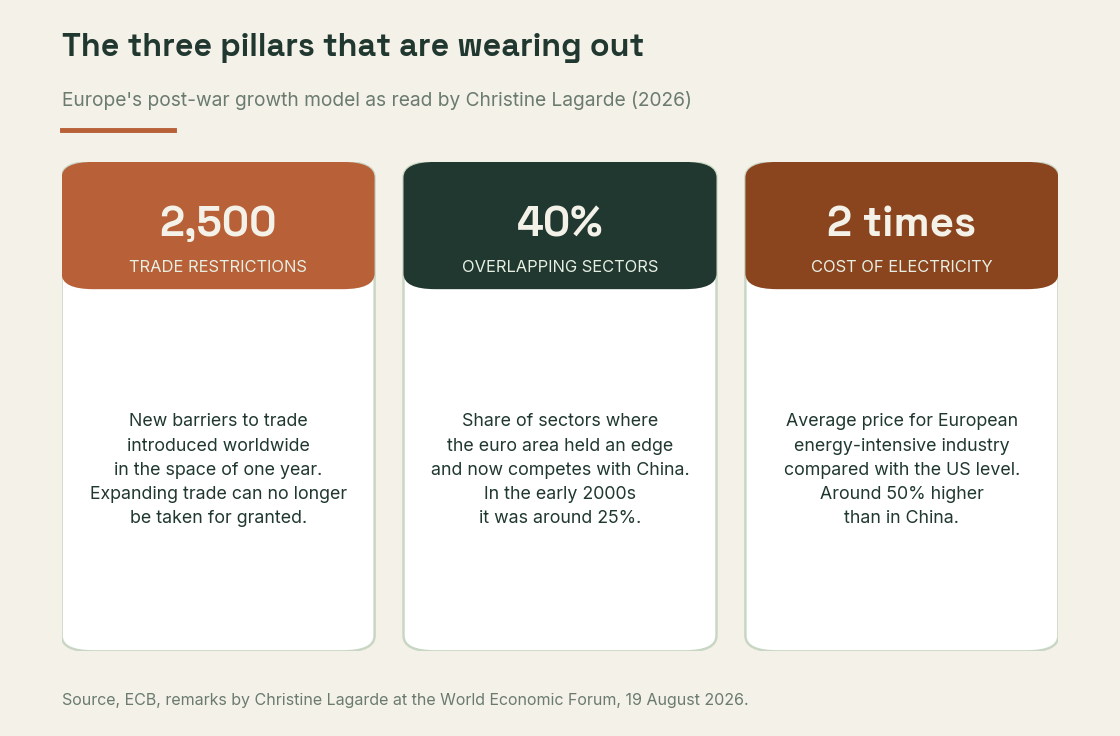 The three pillars of the European growth model that Lagarde considers to be eroding. Source ECB, remarks by Christine Lagarde at the World Economic Forum, 19 August 2026.
Inside that frame comes the passage the press picked up everywhere.
Europe largely missed out on the first digital revolution, as the commercial gains from the spread of information and communication technologies were captured disproportionately elsewhere. We cannot afford to repeat that experience with artificial intelligence (AI), the second digital revolution.
The rest of the speech points to two precise bottlenecks, and neither of them is technological. The first is the fragmentation of the Single Market. The second is the fragmentation of capital markets. According to Lagarde, EU scale-ups raise broadly similar amounts to San Francisco based peers during their first five years, but by year ten they have raised roughly 50% less. And some 12% of EU scale-ups have already moved outside the Union, most notably to the United States.
The gap is not where you think it is
This is where it pays to slow down, because the public story about Europe's lag confuses two different things, namely how many organisations have switched AI on and how deeply they use it.
On the first count the distance is far smaller than commonly claimed. According to Eurostat, in 2025 some 19.95% of EU enterprises used at least one AI technology, up 6.5 percentage points in a single year. In the United States the Census Bureau's Business Trends and Outlook Survey puts reported use between 17% and 20% from December 2025 to May 2026. Those numbers are broadly the same. The European Investment Bank survey for 2025, run on more than 12,000 European firms and over 800 US ones, reaches the same conclusion about the entry point, namely 37% of European firms report deploying generative AI against 36% of American ones.
The gap opens immediately after. In that same survey, 81% of US firms use AI across more than two business activities, against 55% of European ones. In plain terms, in Europe the technology comes in and then stops inside one department. In the United States it crosses the organisation, from customer service to internal processes, from marketing to human resources.
The same pattern shows up at the level of people. Research prepared for the Brookings Papers on Economic Activity spring 2026 conference records 43% of US workers saying they use AI for their job, against much lower European figures, from 36.3% in the United Kingdom to 25.6% in Italy. More tellingly it measures intensity, given that in the United States AI takes up on average 5.2% of hours worked, roughly double the level in the United Kingdom, Sweden and the Netherlands.
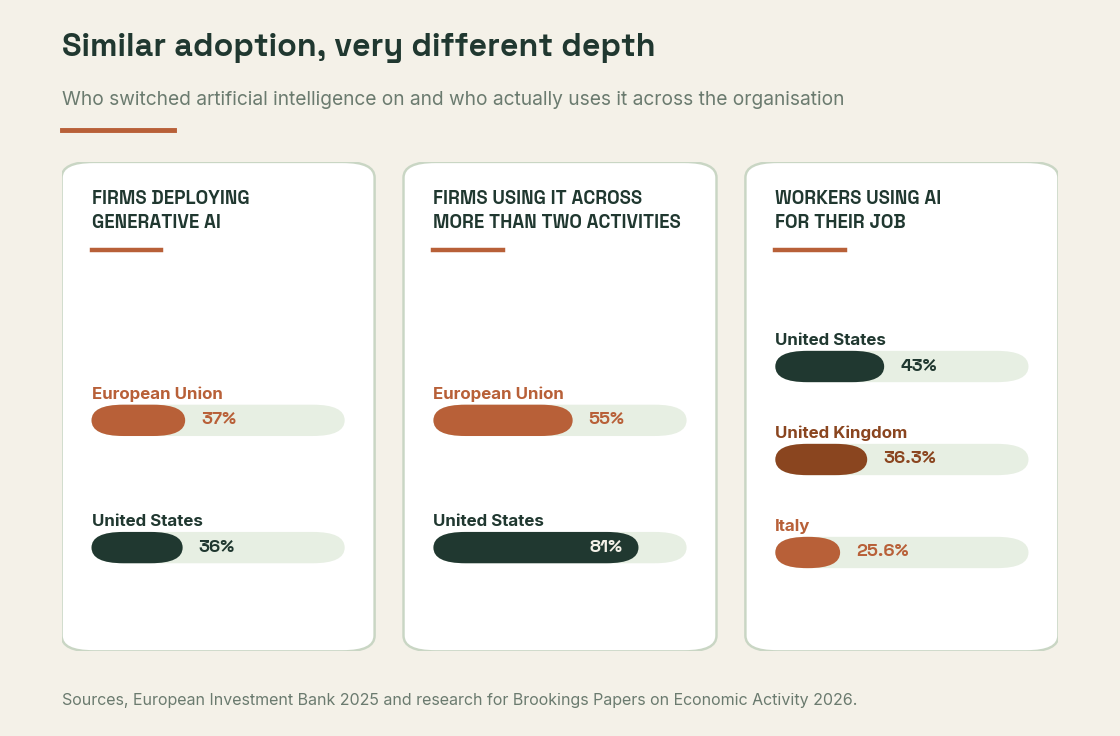 Similar adoption at the door, very different depth of use inside the organisation. Sources Eurostat 2025, US Census Bureau BTOS 2026 and European Investment Bank 2025.
This is exactly the theme we covered in our piece on the productivity paradox. Buying AI is an event. Using it is an organisational process, and the second does not automatically follow the first.
Where the gap really is structural
On capital and compute the distance is not a matter of organisational maturity. It is a matter of orders of magnitude.
Private investment in 2025, as reported by the AI Index 2026, gives 285.9 billion dollars to the United States, 20.9 to Europe as a whole and 12.4 to China. On compute the picture is starker still. According to Epoch AI, as of May 2025 the United States hosted about three quarters of global GPU cluster performance, with China around 15% and the rest of the world, Europe included, sharing the remaining tenth. The AI Index counts 5,427 AI oriented data centres in the United States, more than ten times any other country. And looking at single machines, in mid 2026 the largest US AI supercomputer drew around 1,250 megawatts, against 83 megawatts for the largest European installation.
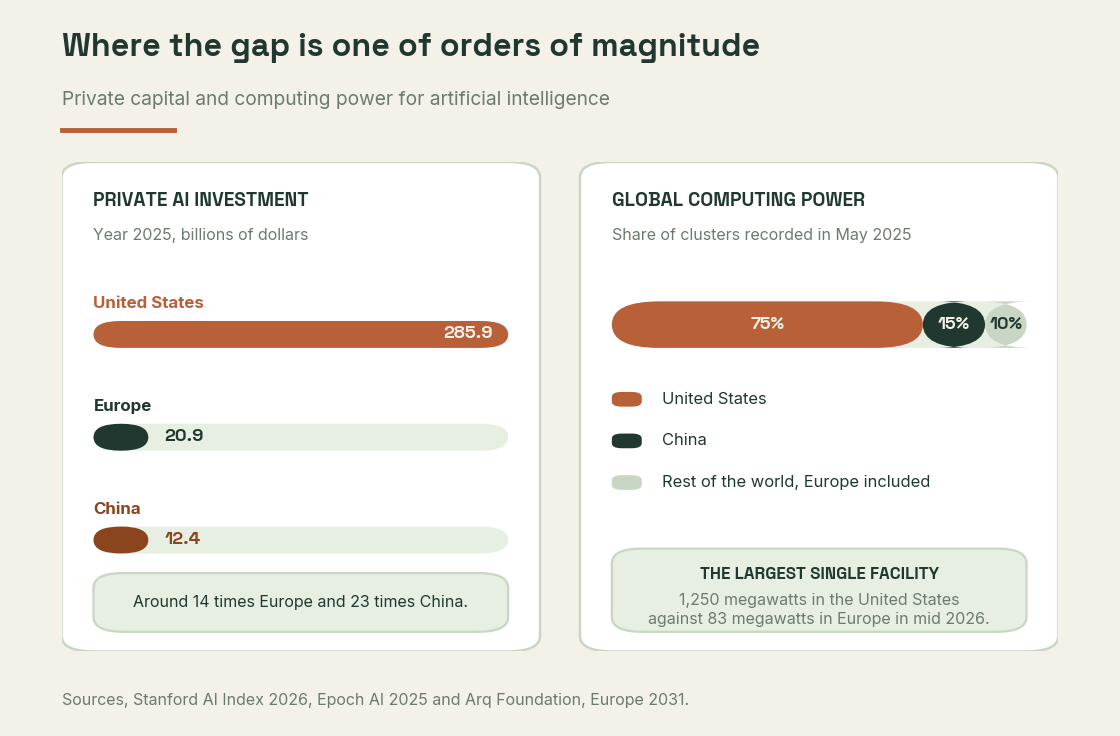 Private capital and compute, the two fronts where the distance is measured in orders of magnitude. Sources Stanford AI Index 2026 and Epoch AI 2025.
China, for its part, plays a different game from both. In 2024 it was granted about three quarters of the world's AI patents, it leads on the volume of scientific publications in the field, and it installed more than half of the industrial robots sold on the planet. On models the catch up is striking, given that the performance gap between the best American model and the best Chinese one has narrowed to 2.7%, while in May 2023 it was above 17%. In the most recent year on record the United States released around fifty notable models, China around thirty, and Europe two or three depending on the counting criteria.
The cards Europe is holding
This is not a continent without resources. It is a continent that does not convert them.
The European Union accounts for around 6% of the world's population but hosts 15% of its researchers, and it produces almost one fifth of the world's most cited scientific publications. It has the widest network of trade agreements in existence and an integrated market of 450 million consumers, the largest among advanced economies. Industrially it keeps an edge precisely where AI is beginning to produce measurable value, given that Interface's analysis of 24,468 European startups puts the continent ahead of the United States in the share of AI companies working on manufacturing and supply chains, 45% against 39%.
European private capital is moving too. Lagarde cited survey evidence that euro area firms expect to allocate an average of around 9% of their total investment to AI this year, and pointed to a measurable imitation effect, since a one percentage point rise in the perceived share of domestic competitors investing in AI raises a firm's own expected AI investment rate by around 0.6 percentage points.
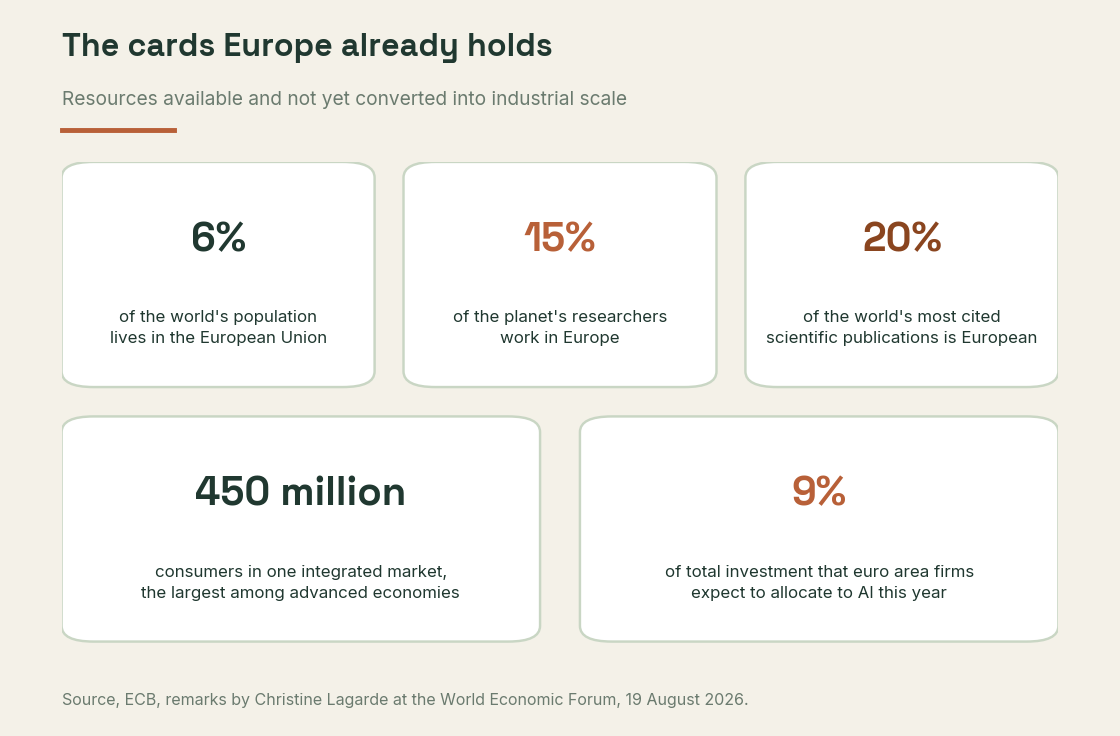 The resources Europe already holds and has so far failed to convert into industrial scale. Sources ECB 2026 and Interface 2026.
On the public side, the Commission's AI Continent Action Plan mobilises around 20 billion euro through InvestAI, targets at least thirteen operational AI Factories and up to five gigafactories, and states the goal of tripling EU data centre capacity within five to seven years. Those are serious figures, but they should be read next to an uncomfortable projection. The Europe 2031 scenario prepared by the Arq Foundation estimates that, on the current path, by 2031 Europe would still hold only about 5% of global AI compute, against 80% for the United States.
Meanwhile the regulatory picture has moved towards simplification. Since 27 July 2026 the AI Omnibus has postponed the rules on standalone high risk systems to 2 December 2027 and those on systems embedded in already regulated products to 2 August 2028, while keeping transparency and AI literacy obligations in force, as we explained in our piece on what changes with the AI Omnibus. The time firms gained is not free time. It is preparation time.
What this means for your organisation
No school, company or public body can do anything about gigawatts. But the part of the gap that weighs most in daily practice is not measured in gigawatts, it is depth of use, and that is precisely the part you can act on.
- Stop measuring adoption by counting activated licences. Measure how many distinct activities AI has genuinely entered, because that is where the gap between Europe and the United States opens.
- Start from the processes where you already hold an information advantage, namely your own domain data. The documented European edge sits in vertical sectors, not in general purpose models.
- Treat training as infrastructure rather than as a compliance item. Italy remains among the last countries in Europe for generative AI use among people, which we covered in Italy is second to last in Europe for AI use.
- Use the window opened by the AI Omnibus to put data, roles and responsibilities in order ahead of the 2027 and 2028 deadlines.
- Check the organisational preconditions before buying more technology, the ones we called Systemic Readiness.
Lagarde's sentence works as a macroeconomic diagnosis, but it also works as a very concrete question addressed to anyone running an organisation. Europe watched the first digital revolution go by because it kept using technology built elsewhere without building scale of its own. The second turns on the same distinction, between those who install tools and those who redesign the way they work.
Where to start
If you want to know where you actually stand, the first step is not choosing a vendor. It is running a diagnosis. Our AI Readiness Report photographs the real level of your school, public body or company, measures how many activities AI has already entered and where processes stall, and tells you where it makes sense to begin, with a measurement before and after the programme that leaves you a document you can also use to report on public funding. Write to us for an AI readiness assessment, or read our manifesto to see how we work.
Methodological note
This article is informative in nature and does not constitute legal or investment advice.
AI adoption figures are not directly comparable with one another and should be read as measurements of different phenomena. Eurostat records the use of at least one AI technology across a broad, representative sample of European enterprises with ten or more employees, so it includes very many small firms and returns low values. The US Business Trends and Outlook Survey asks firms whether they used AI in the preceding two weeks, so it measures a narrow time window. The European Investment Bank survey focuses on generative AI in non micro firms and returns much higher shares. Surveys of executives in large organisations, which report figures close to 90%, measure a different universe again. Treating these numbers as if they measured the same thing is the most common error in the public debate on this topic.
The private investment figures from the AI Index 2026 are based on tracked market transactions and exclude direct public spending and state guided venture funds, which materially understates the Chinese effort. The European perimeter aggregates EU and non EU countries depending on the source, so it should be read as an order of magnitude rather than a point estimate.
Epoch AI's compute shares refer to publicly documented clusters as of May 2025 and by construction understate undisclosed installations, particularly Chinese ones. The Europe 2031 scenario is a projection based on its authors' explicit assumptions, not an official forecast, and should be treated as a scenario exercise.
Counts of notable models by geography depend on each observatory's inclusion criteria, which is why available sources report between two and three models for Europe over the same period. In the same way, Chinese shares of patents and publications shift noticeably depending on whether filings or grants are counted, and on which journals are included, so they are reported here as orders of magnitude.
Sources
- European Central Bank, Panel remarks about the European economy during a discussion on the global economic outlook at the World Economic Forum, remarks by Christine Lagarde, International Business Council, Geneva, 19 August 2026.
- Stanford HAI, The 2026 AI Index Report, research and development and economy chapters (2026).
- Eurostat, Use of artificial intelligence in enterprises, data extracted December 2025.
- US Census Bureau, Large Firms With at Least 20 Employees Biggest AI Users, Business Trends and Outlook Survey (May 2026).
- European Investment Bank, European firms show resilience, invest in green transition, and match US companies in adopting AI technologies, EIB Investment Survey (2025).
- Federal Reserve Bank of St. Louis, Mind the Gap. AI Adoption in Europe and the U.S., research prepared for Brookings Papers on Economic Activity (2026).
- Epoch AI, The US hosts the majority of GPU cluster performance, followed by China, data as of May 2025.
- European Commission, AI Continent Action Plan (2025).
- Interface, European AI Competitiveness Beyond Frontier Models, analysis of 24,468 startups, Dealroom data (May 2026).
- Arq Foundation, Europe 2031, Compute Forecast (2026).
- Regulation (EU) 2026/1744, AI Omnibus, in force since 27 July 2026.