
Italy is second-to-last in Europe for AI use
When people discuss Italy's lag on artificial intelligence, the convenient explanation is always the same, namely "we don't have the technology". The data tell a different story. According to Eurostat, in 2025 32.7% of Europeans aged 16 to 74 used generative AI tools. In Italy the figure stops at 19.9%, second-to-last in the Union, ahead of Romania alone.
Yet the technology is identical for everyone. ChatGPT, Gemini and the rest are one click away in Denmark as in Italy. If Danes use them two and a half times more than we do, the difference is not access to the tool. It is what it takes to use it well, namely skills.
Second-to-last in Europe
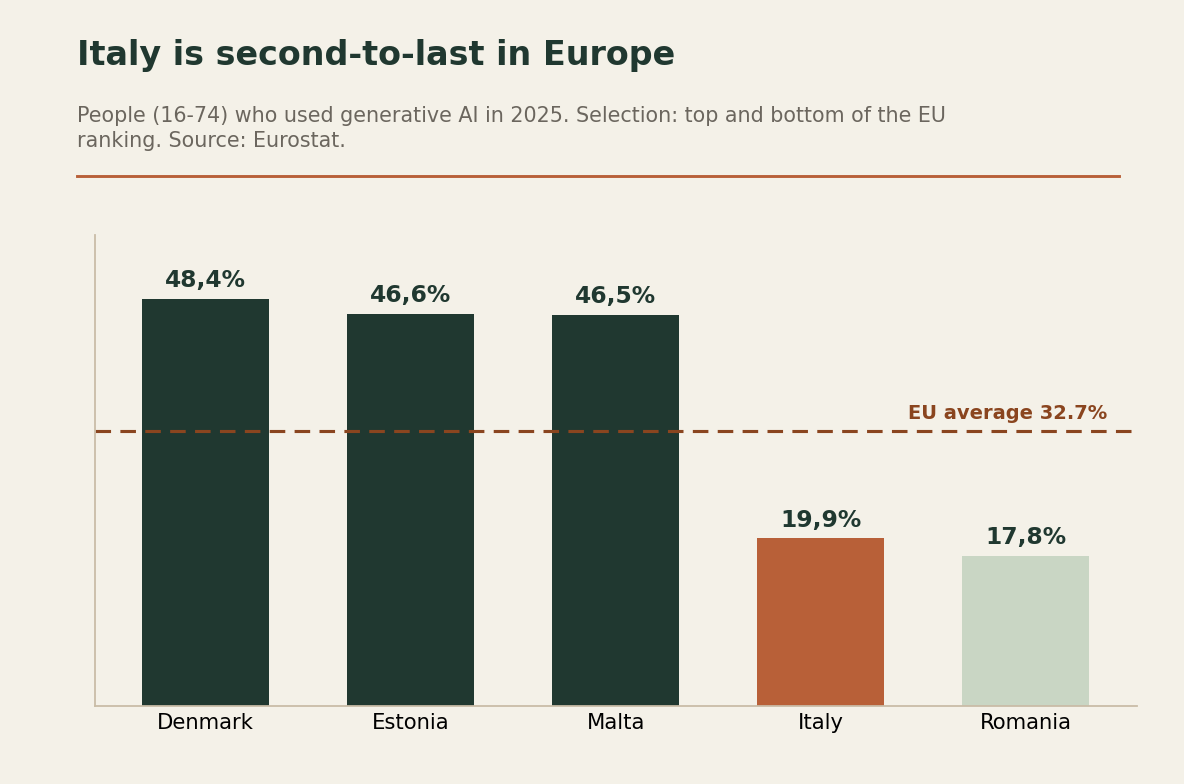
Use of generative AI in 2025 across the top and bottom of the EU ranking. Source Eurostat.
The Eurostat 2025 picture is clear. At the top are Denmark (48.4%), Estonia (46.6%) and Malta (46.5%). The EU average is 32.7%. Italy stops at 19.9%, followed only by Romania. This is not a statistical nuance, namely thirteen points below the European average and almost thirty below the leading countries.
The gap affects daily life, work and study
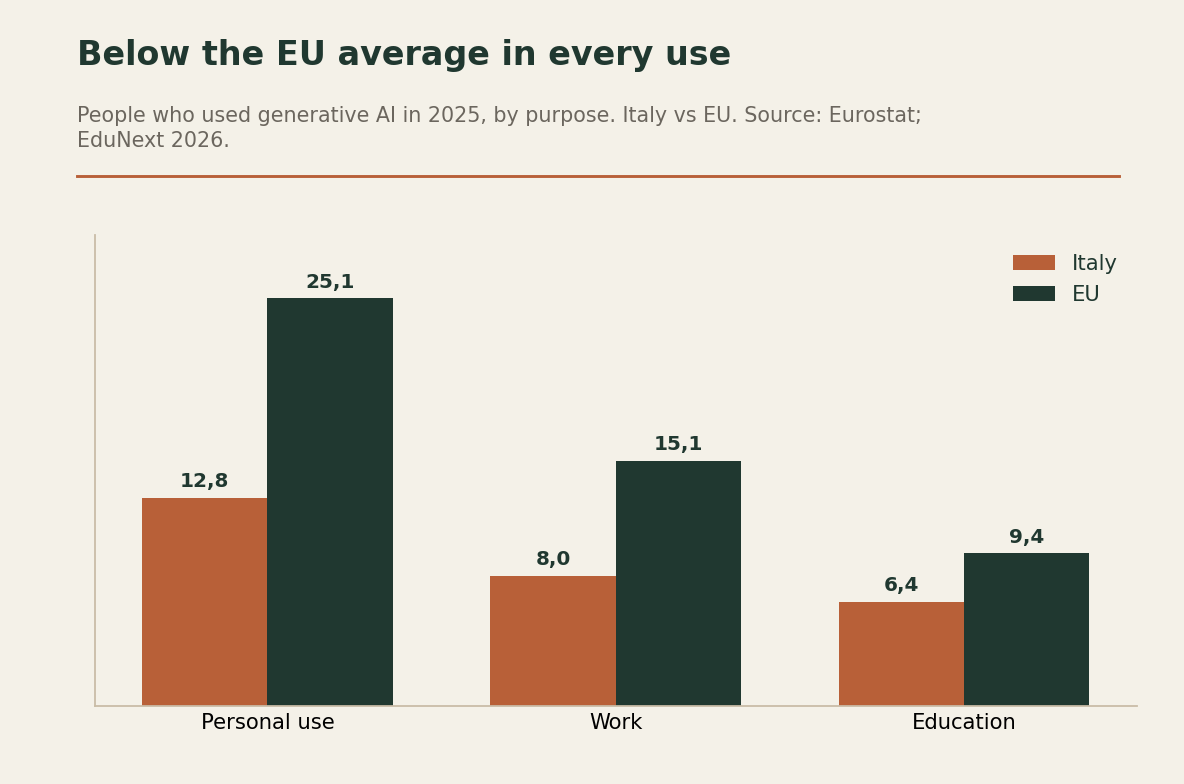
Use of AI by purpose, Italy and EU in 2025. Source Eurostat and EduNext 2026.
The lag concerns more than one area. According to the EduNext 2026 report (Luiss and Intesa Sanpaolo, on Eurostat data), Italy is below the EU average in every area, namely in daily life (12.8% vs 25.1%), at work (8% vs 15.1%) and in education (6.4% vs 9.4%). And it is not about age, given that in Europe 64% of young people aged 16 to 24 used AI in 2025. Italy's gap is not generational, but systemic.
Firms are accelerating, but we are lagging
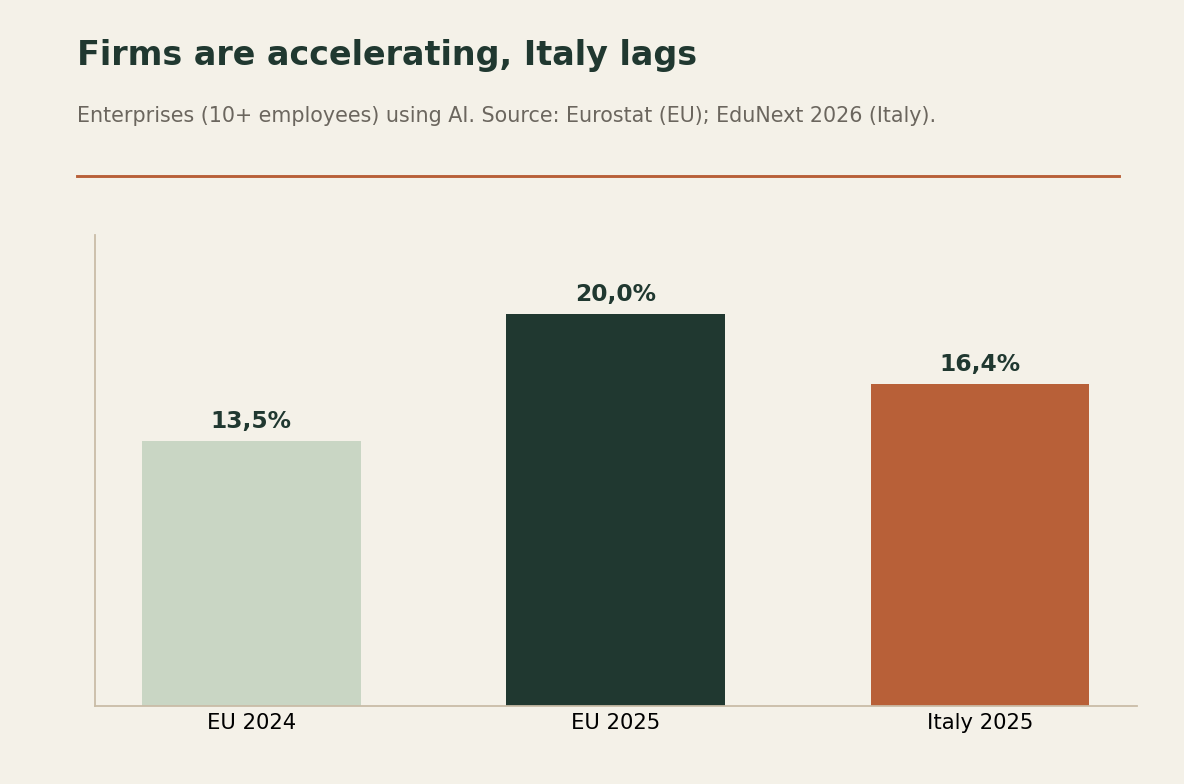
Enterprises with at least ten employees using AI. Source Eurostat for EU and EduNext 2026 for Italy.
Among companies there is movement. In 2025, 20% of EU enterprises with at least ten employees use AI, up sharply from 13.5% in 2024. Italy has doubled on the previous year, reaching 16.4%, a real progress but still below the EU average. Here too the Nordic countries lead (Denmark 42%, Finland 37.8%, Sweden 35%).
The cause is not technology, it's skills
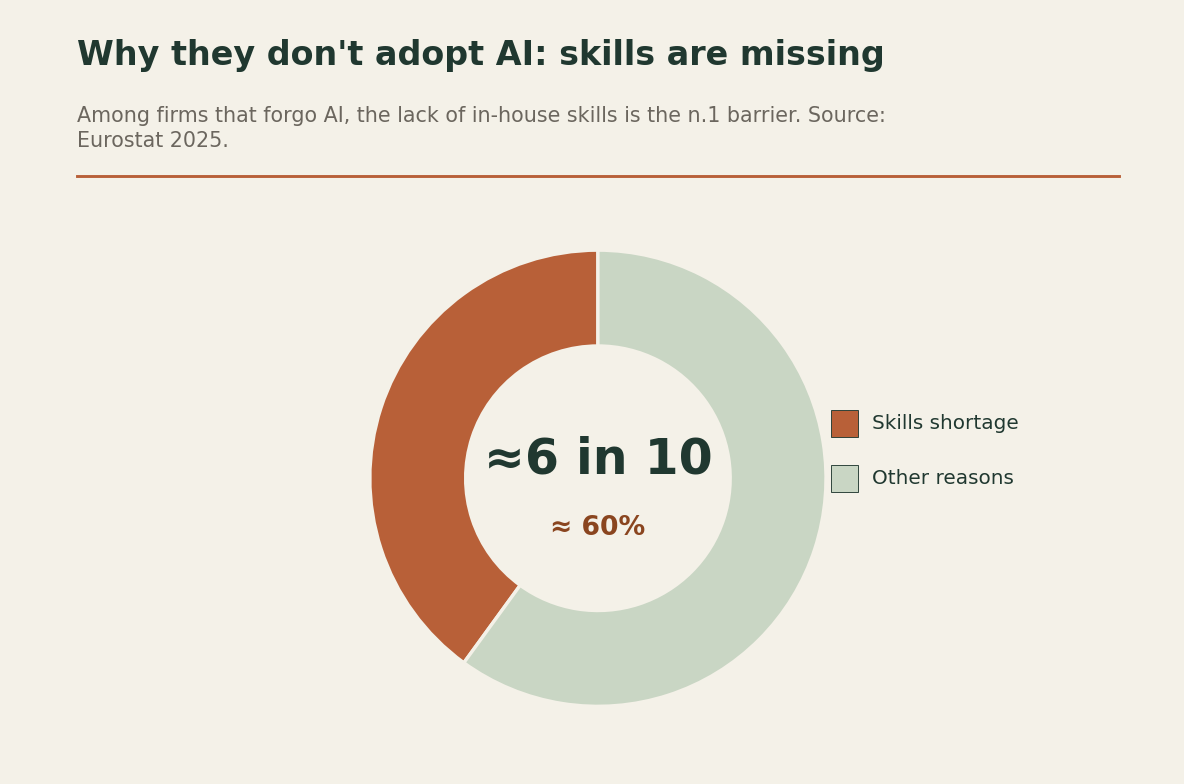
The main barrier to AI adoption among enterprises, source Eurostat 2025.
When firms are asked why they do not adopt AI, the answer is almost always the same. According to Eurostat, around six in ten companies that forgo AI cite a lack of in-house skills as the main barrier, followed by data privacy concerns and legal uncertainty. Not "there is no technology", but "we don't know how to use it".
And the problem runs deep. In 2025 only 45.8% of Italians have basic digital skills, against an EU average of 55.6%, and the figure is even down from 2022. The European target for 2030 is 80%. Without a leap in training, that goal remains distant.
What this gap really tells us
The numbers tell a coherent story. The countries that use AI the most are the same ones that invest the most in digital skills, with Northern Europe leading both rankings. This is no coincidence. Technology is a commodity, available to all at the same price. The difference is made by people who know what to ask it, how to check its answers and when not to trust it.
This is exactly why Europe has made AI literacy a legal duty, through Article 4 of the AI Act (we wrote about it here), and why research shows that adopting AI without skills produces frustration, not value.
Where we stand
Retoria exists to close precisely this gap. We do not hand out software, but critical literacy to understand how AI works, where it fails, how to verify it, and why language and thinking remain the lever with which we govern it (namely our method). Italy's lag is not closed by buying more technology. It is closed by training people.
To evaluate your organization's level of AI readiness you can get in touch here, or learn more about how passive AI use affects cognitive abilities.
Methodological note
Data on individual and enterprise use come from Eurostat 2025 surveys. Comparisons by purpose and the figure for Italian enterprises are taken from the EduNext 2026 report (Luiss and Intesa Sanpaolo, on Eurostat elaborations, CC BY 4.0). Data on basic digital skills come from the European Commission's Digital Decade monitoring. Percentages may vary slightly across sources due to method and reference period.
Sources
- Eurostat — 32.7% of EU people used generative AI tools in 2025.
- Eurostat — 20% of EU enterprises use AI technologies (2025).
- Eurostat — Use of artificial intelligence by individuals (Statistics Explained).
- European Commission — Digital Decade 2025, Italy country report (basic digital skills).
- Look4ward Observatory, Luiss & Intesa Sanpaolo — EDUNext 2026 (CC BY 4.0).