The more expert you feel with AI, the worse you judge yourself
For ten years we used the phrase digital divide to mean one thing only, namely the device that is missing, the connection that never arrives, the licence nobody can afford. Then the most powerful tool ever placed in a student's hands showed up, and it is free and it lives inside a browser. The EduNext 2026 report settles the question in a single line that carries the whole chapter, namely that it is not access that creates the divide, it is the quality of use.
The fracture has moved inside the head of the person who already owns the tool. It also has a technical name, the metacognitive gap, and it measures one precise distance, the one between how good you actually are and how good you believe you are while working with a machine that writes better than you do. This point matters a great deal, because a skill you do not know you lack is a skill you cannot go and get.
The bifurcation that widens on its own
EduNext puts the argument plainly. People who use AI strategically, meaning to formulate better questions, build denser interpretations and move through ambiguity that will not resolve, gain a multiplier on their own capability. People who use it as an oracle, handing over the answer without developing the judgment, lose capability through disuse. And the mechanism feeds itself, since those who start ahead use the tool in more sophisticated ways and widen the gap further, while those who start behind use it passively and weaken themselves further still.
It is a convincing thesis and we share it. But something awkward has to be said here, because we cite this report often and we want to cite it well. EduNext rests the loss of capability on a 2011 paper by Sparrow, Liu and Wegner, the well known work on Google effects on memory. That result did not hold up. In 2018 the Social Sciences Replication Project led by Camerer and colleagues re-ran every experiment published in Nature and Science between 2010 and 2015, and for that study the replication failed, with an effect pointing in the same direction but no significance, neither in the first round of data collection nor in the two rounds pooled.
This is not a footnote. It means the evidence for the metacognitive gap does not sit in memory that withers, which remains an unconfirmed hypothesis. It sits somewhere else, and the evidence there is both newer and far more solid.
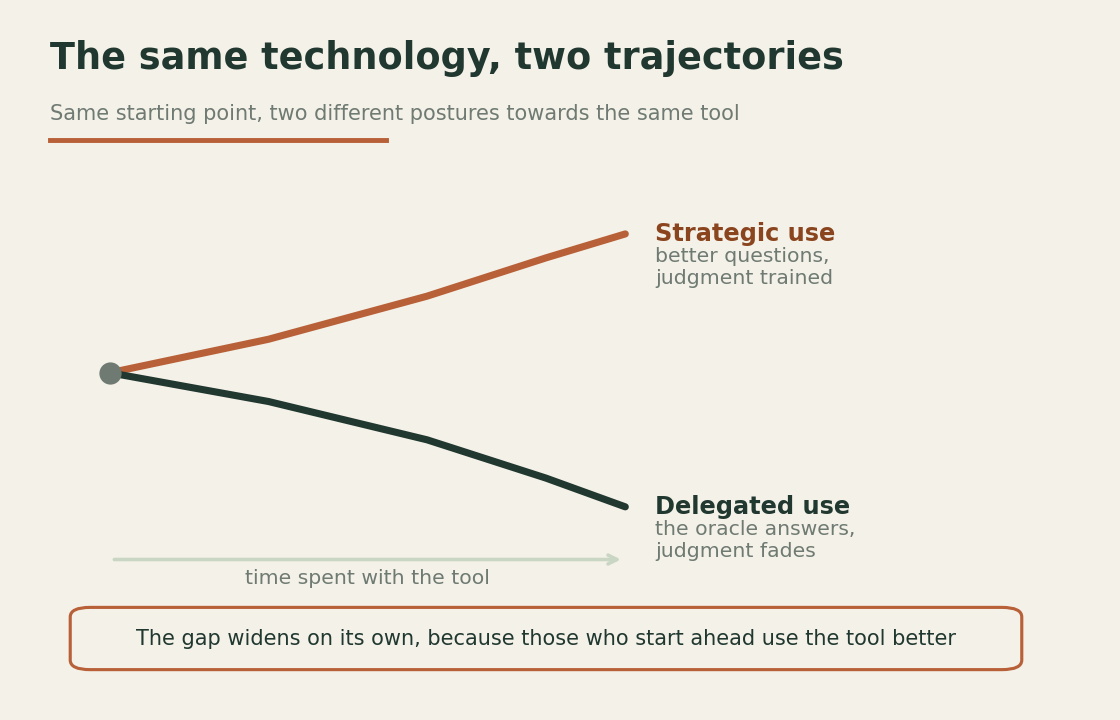 The bifurcation described by EduNext. The same technology produces opposite outcomes depending on the cognitive posture of the person using it. Retoria analysis based on Osservatorio Look4ward, Luiss and Intesa Sanpaolo, EDUNext 2026.
The finding that holds, namely calibration that breaks
In October 2025 Robin Welsch and Daniela da Silva Fernandes of Aalto University published an experiment in Computers in Human Behavior that goes straight to the point. Around 500 participants, two studies, logical reasoning items taken from the American law school admission test. Half work with ChatGPT, half without. And everyone is asked to estimate how well they did, with payment tied to the accuracy of that estimate, so that guessing carries a cost.
The result comes in two halves and has to be read together. People using AI solved the items better, which nobody disputes. At the same time they lost the ability to estimate their own performance, overrating it significantly. The title the authors chose says it better than any summary, namely that AI makes you smarter but none the wiser.
Then comes the part that should give pause to anyone who designs training. The familiar pattern in which it is the unskilled who overrate themselves does not appear here at all. It inverts. People who describe themselves as more AI literate overrate themselves more than the others, not less. And the behaviour that explains it is mundane and visible in any classroom, since most participants asked a single question per item. One pass. No second round, no check, no comparison.
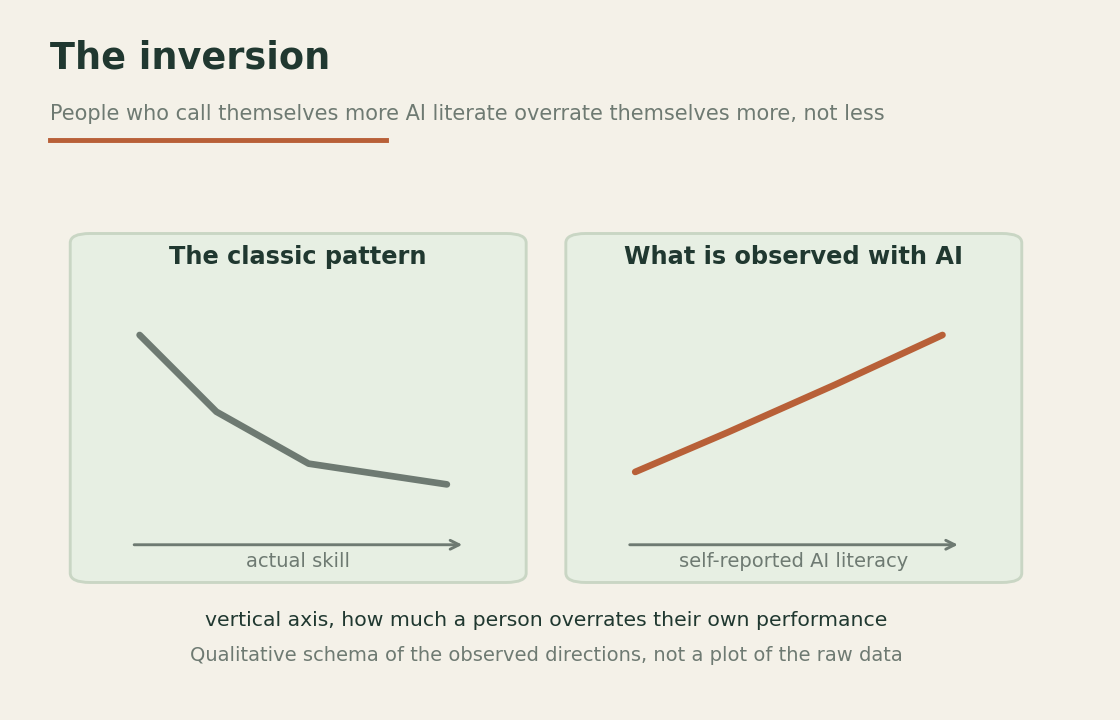 With AI the relationship inverts. Qualitative schema of the directions measured by Welsch and da Silva Fernandes, Computers in Human Behavior (2025).
The more you trust the machine, the less you think
The same mechanism shows up in offices, not only in classrooms. At the CHI 2025 conference a team from Microsoft Research and Carnegie Mellon University presented a survey of 319 knowledge workers, who described real uses of generative AI in their daily work. The correlation that emerges is almost mechanical. The more confidence a worker places in the tool's ability to handle the task, the less critical effort that worker reports having spent. The more confidence they place in themselves, the more critical effort they spend.
The nature of that effort changes as well. It shifts from producing information to verifying it, from solving a problem to integrating an answer that arrives ready made. That is not a loss in itself, provided the verification actually happens. When it does not, only the integration is left, which is copy and paste with a thin coat of oversight.
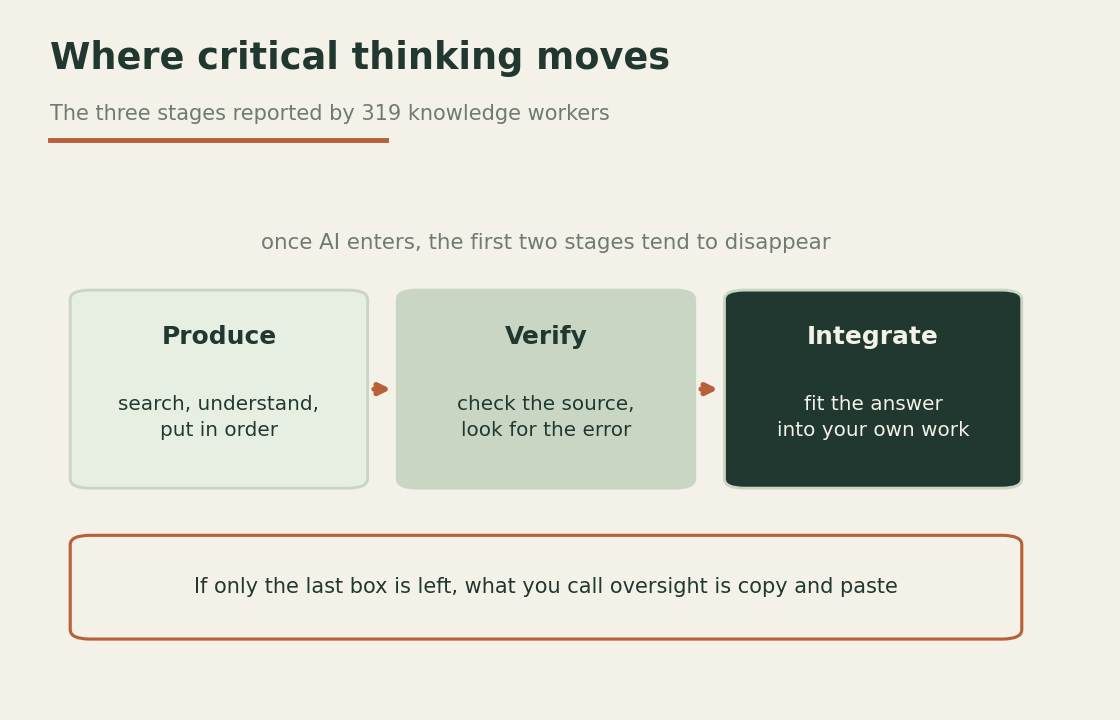 Where critical thinking moves once AI enters the workflow. The risk is that only the last step survives. Retoria analysis based on Lee and colleagues, CHI 2025.
In the classroom, metacognitive laziness
On the teaching side the cleanest measurement comes from an experiment published in 2025 in the British Journal of Educational Technology by Fan, Gašević and colleagues. One hundred and seventeen university students, four support conditions during a writing task, namely ChatGPT, a human expert, an automated writing analytics tool, or nothing at all. The ChatGPT group achieved the largest improvement on the score of the essay they handed in. On knowledge gain and on transfer, meaning the ability to reuse what you learned in a new situation, no advantage at all. The authors call the phenomenon metacognitive laziness, namely giving up on monitoring your own thinking once something else is doing it for you.
The picture closes with the experiment by Bastani and colleagues, published in 2025 in PNAS, on nearly a thousand high school students in Turkey. With open access to GPT-4 during practice, results rise by 48%. Then comes the exam without the assistant, and those same students score 17% below classmates who never had the assistant at all. The version with pedagogical constraints built in, which the researchers call GPT Tutor, wipes out the harm. It is not the technology that makes the difference, it is the way the technology is built.
If you read our article on the AI learning penalty you will recognise the same pattern on an even larger scale, namely the 26,000 students followed for thirty months by Strömberg, Lei and Wu.
The tension the report leaves open
On page 43 EduNext does something institutional reports almost never do, which is to list the contradictions it cannot resolve. One of them bears directly on this subject. On one side, people running advanced hybrid teams argue that every month of delay in adopting AI is competitiveness lost, and the market will not wait for cognitive foundations to be built. On the other, people who study cognitive processes argue that speed without foundations produces passive users, and that passivity reproduces itself. Both positions rest on evidence. The report states that the tension cannot be composed within its own material and calls for political choices that research can inform but not replace.
Next to it sits a second contradiction, just as rough. AI democratises access to knowledge, and at the very same moment the economic returns concentrate in the hands of a very small number of players who control the infrastructure. More access for many, more power for very few. Here too the report records the fact without offering a synthesis, because the synthesis is not in the data.
Our reading is this. Waiting is not an option, and neither is adopting without building. The only workable space is to grow the two things together, meaning to introduce the tool and train the judgment inside the same activity, rather than in two separate courses months apart.
Four moves you can make on Monday
You do not need a new platform and you do not need to wait for a reform. What follows is what we use in Retoria classrooms, and it works with teachers as well as with company managers.
- Your answer first, then the machine. A properly written draft before you open the model, even a rough one, even a short one. Anyone who asks from a standing start has nothing to compare the answer against.
- Estimate before you know. Before handing in, write down the mark you think you will get. Comparing the estimate against the real mark is the cheapest exercise there is for repairing calibration, and calibration is exactly what AI breaks.
- No single questions. One request and done is the behaviour measured in the Aalto study, and it is the marker of delegation. Make the second round mandatory, meaning ask the machine where it might be wrong and check at least one fact against an outside source.
- At least one assessment without it. If the only measure you collect is an assisted performance, you are not measuring learning, you are measuring the tool.
What this means for your organisation
If you are bringing AI into a school, a professional practice or a company, the right question is not which tool to adopt, it is whether the people who will use it can tell when the answer they receive is wrong. That is something you can measure, and it is worth measuring before rather than after. This is precisely what Retoria does, namely assessing an organisation's real readiness for AI and building the training path that follows from it. Write to us for an AI readiness assessment, or read why Retoria exists and how we work.
Methodological note
The sources cited here do not all carry the same weight and it is only fair to say so. The Aalto study and the Bastani study are randomised experiments with measures collected under controlled conditions, so they support a causal reading. The Bastani study, however, ran in a single secondary school in Turkey with ninth, tenth and eleventh grade mathematics classes, so it is strong on causation and modest on generalisation. The Microsoft and Carnegie Mellon survey relies on participants' own accounts, so it shows a correlation rather than a cause, and it depends on how well people can describe their own mental effort. The Fan study has a sample of 117 university students on a single writing task, so read it as a signal and not as a general law.
Two further warnings. The Sparrow, Liu and Wegner study from 2011, cited by EduNext and in the past by us as well, failed to replicate in 2018, and from today we treat it as an open hypothesis rather than as evidence. The classic Dunning and Kruger effect, also cited by the report, has been at the centre of a serious statistical argument for years, since a substantial part of the phenomenon can be explained by regression to the mean and by the way the data are grouped. That is why we do not use it as evidence in this article, and why the Aalto work is more useful, precisely because it measures calibration directly instead of inferring it.
This article is neither legal nor clinical advice. It is about learning and about how work is organised.
Sources
- Osservatorio Look4ward, Luiss Research Center for Strategic Change "Franco Fontana" and Intesa Sanpaolo (2026). EDUNext: Nuovi scenari per l'Education e le competenze nell'era dell'IA. Licensed CC BY 4.0.
- Welsch, R. and da Silva Fernandes, D. (2025). AI makes you smarter but none the wiser: The disconnect between performance and metacognition. Computers in Human Behavior, 175.
- Lee, H.-P. et al., Microsoft Research and Carnegie Mellon University (2025). The Impact of Generative AI on Critical Thinking: Self-Reported Reductions in Cognitive Effort and Confidence Effects From a Survey of Knowledge Workers. Proceedings of CHI 2025.
- Fan, Y., Tang, L., Le, H., Gašević, D. et al. (2025). Beware of metacognitive laziness: Effects of generative artificial intelligence on learning motivation, processes, and performance. British Journal of Educational Technology.
- Bastani, H., Bastani, O., Sungu, A. et al. (2025). Generative AI without guardrails can harm learning: Evidence from high school mathematics. Proceedings of the National Academy of Sciences, 122(26).
- Camerer, C. F. et al. (2018). Evaluating the replicability of social science experiments in Nature and Science between 2010 and 2015. Nature Human Behaviour.
- Sparrow, B., Liu, J. and Wegner, D. M. (2011). Google effects on memory: Cognitive consequences of having information at our fingertips. Science, 333(6043).
- Gignac, G. E. and Zajenkowski, M. (2020). The Dunning-Kruger effect is (mostly) a statistical artefact: Valid approaches to testing the hypothesis with individual differences data. Intelligence, 80.