
The 5 preconditions nobody talks about, namely Systemic Readiness
There is a finding that recurs in almost every account from senior leaders and that public debate keeps ignoring. Artificial intelligence does not produce value automatically. Its effectiveness depends on conditions that must exist beforehand, and that in most Italian organisations are not yet in place in any structured way.
The EduNext 2026 report by the Look4ward Observatory (Luiss and Intesa Sanpaolo) calls them "systemic preconditions" and gathers them into one construct, Systemic Readiness. They are five dimensions, and their absence determines the failure of the most ambitiously announced AI initiatives. Buying the tool is easy; preparing the ground so it works is the real job, and it is almost always the part that is missing.
More than 8 in 10 projects fail
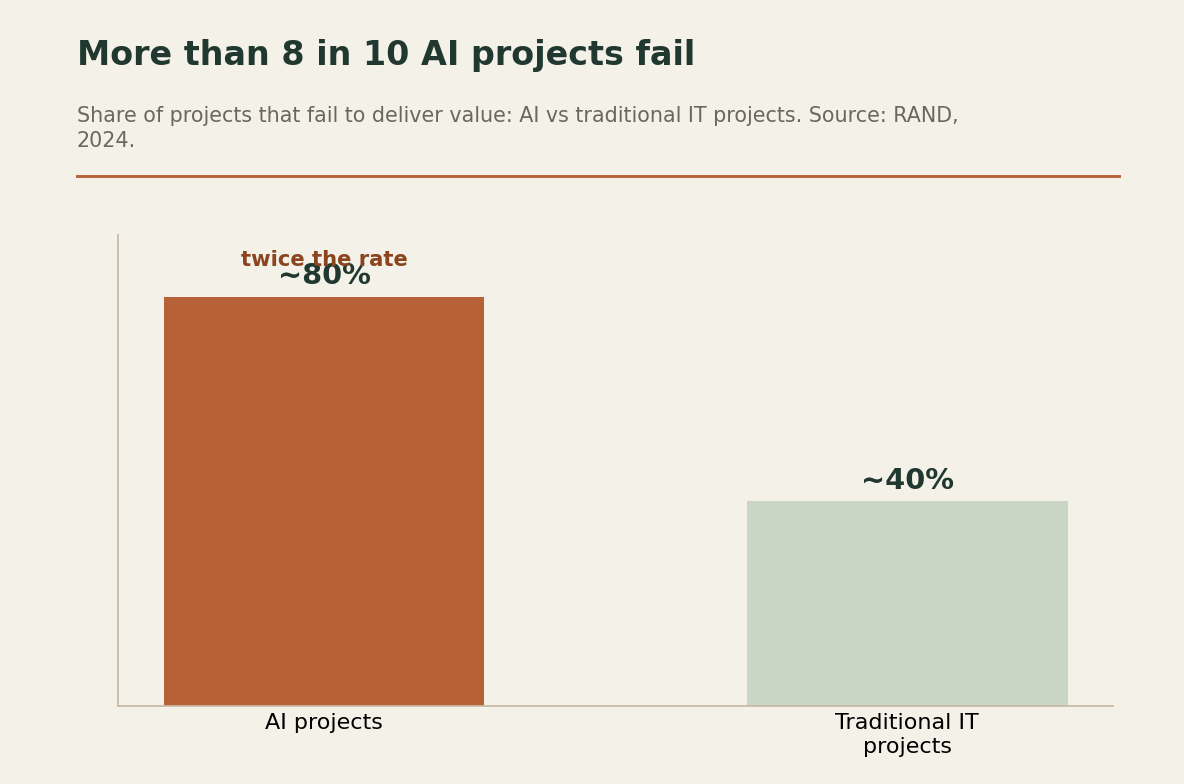
Share of projects that fail to deliver value. Source RAND, 2024.
This is not an impression. A 2024 RAND Corporation study, based on interviews with sixty-five experienced data scientists and engineers, estimates that more than 80% of AI projects fail, twice the already-high failure rate of traditional IT projects. The recurring causes are not technological. They are the poorly defined problem, insufficient data, a bias toward the newest technology rather than the real problem, and infrastructure inadequate to manage data and models. The same message as the EduNext corpus, from another angle.
"The limit is not the technology, it is the mindset, the culture and what people are able to do. Organisations that understand this start from a completely different place."
The five dimensions of Systemic Readiness
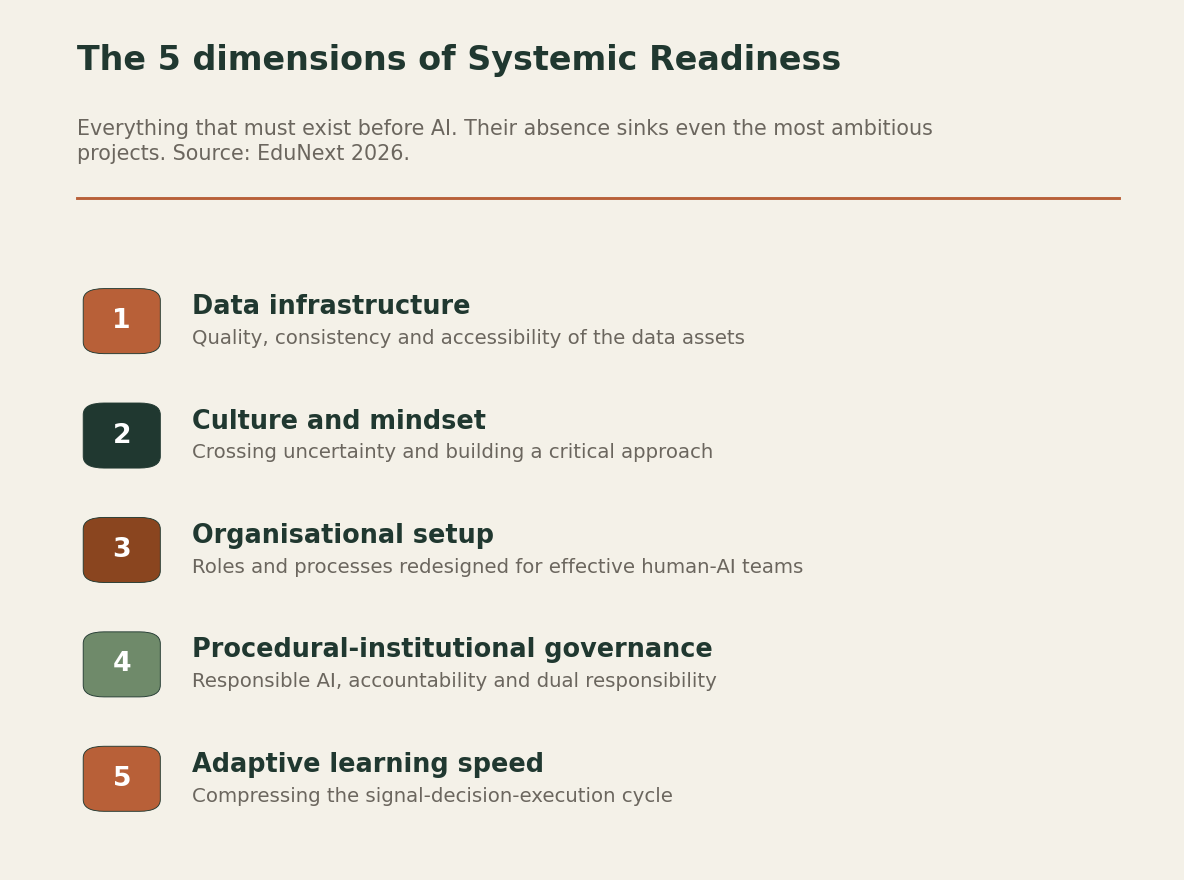
The conditions that must exist before AI. Source EduNext 2026.
The first dimension is data infrastructure, namely the quality, consistency and accessibility of the data assets. Without data in order, every intelligent application starts crippled. The second is culture and mindset, the ability of people to cross uncertainty, accept change and use the tools with a critical eye. The third is organisational setup, namely roles, processes and structures redesigned so that humans and algorithmic agents work together in genuinely effective teams.
The fourth is procedural and institutional governance, made of responsible-AI frameworks, decision accountability and what the report calls dual responsibility, both for adoption and for non-adoption. The fifth, the most original contribution of the research, is adaptive learning speed, the ability to compress the cycle that runs from signal to decision, to execution, to learning. It is this speed that sets the most mature organisations apart from those that fall behind.
The invisible prerequisite, namely data in order
An organisation's maturity is measured not by the tools it adopts but by the quality of the infrastructure those tools run on. Many firms discover they lack the necessary data foundations, namely fragmented databases, inconsistent taxonomies, archives built up over years with no standard logic. A services company interviewed in the report recounts devoting the first year of its transition almost entirely to cleaning its own data. Work that is barely visible, hard to communicate internally, yet indispensable.
"We are not ready because the data is not in order."
Change management comes before technology

The almost universal trajectory of AI adoption. Source EduNext 2026.
The main bottleneck is not technological, it is the ability of people and organisations to change how they work. Leaders' accounts converge on an almost universal trajectory, running through fear, understanding, acceptance and finally fluent use. A non-linear path that requires investment in change management even before technology.
Here is a point we care about deeply, because it touches the very meaning of our work. Training, on its own, is not enough. The head of training at a large organisation puts it honestly, and it is worth listening to.
"Training is a very powerful lever, but it is not training that transforms the organisation. If those who manage people do not create the enabling conditions, training generates frustration: everyone is shown the possibilities, without being able to realise them."
Training without redesigning roles and processes shows people a door that stays shut. That is why effective training always works together with the organisation, not instead of it.
Dual responsibility, namely not adopting has a cost too
There is a dimension of governance that the report introduces forcefully and that overturns the usual view. Normally the risks of adopting AI too quickly are debated. But delay too has a cost, real and competitive, which organisations often fail to account for. Mature leadership recognises and governs both directions of risk, that of adoption and that of omission. It is not about rushing, but about deciding deliberately when to move and when to wait.
"The more urgent something is, the more we have to take our time. Haste in adopting AI is no ally, it is the fastest route to wasting resources and creating resistance that then costs twice as much."
Where to start to measure readiness
The five dimensions are not a theoretical exercise. They are exactly what an organisation should measure before investing, to know where it is ready and where it is not. This is the principle behind our AI readiness work, the Retoria AI Readiness. We do not start from the tools, but from the preconditions, namely data, culture, organisation, governance and the capacity to learn. Building these foundations is what turns a purchase into a result.
This article grows out of work on data and processes, the heart of the administrative function, and from the conviction that transformation is governed, not endured.
To check whether your organization is ready for AI and assess your level of AI readiness, you can get in touch here, discover the Retoria method, or read why buying AI is not enough and why Italy is second-to-last in Europe for AI use.
Methodological note
The five dimensions of Systemic Readiness and the (anonymised) leader quotes come from the EduNext 2026 report (chapter 2.2), based on thirty-two in-depth interviews with senior figures conducted between December 2025 and April 2026, using Constructivist Grounded Theory. The authors read the construct as a specification of dynamic capabilities (Teece, Pisano and Shuen, 1997) in the AI era. The project failure figure comes from the 2024 RAND study of sixty-five experts. The chart percentages are rounded for illustration.
Sources
- RAND Corporation — The Root Causes of Failure for Artificial Intelligence Projects (2024).
- Look4ward Observatory, Luiss Research Center for Strategic Change "Franco Fontana" & Intesa Sanpaolo (2026). EDUNext: New scenarios for Education and skills in the AI era (CC BY 4.0).
- Teece, D. J., Pisano, G. & Shuen, A. (1997). Dynamic capabilities and strategic management. Strategic Management Journal.
- Kotter, J. P. (2012). Leading Change. Harvard Business Review Press.